Productive procrastination: the distraction that looks like work
Busy isn’t the same as focused. One question tells you which one you are.
6 October 2026 · 4 min read
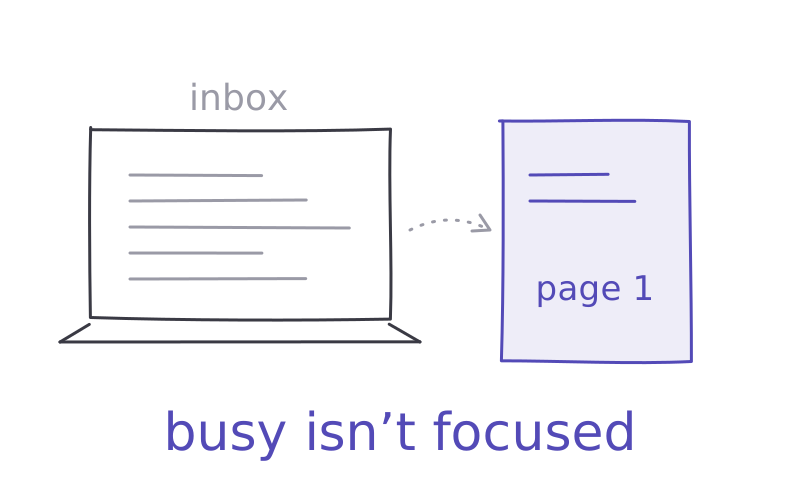
Tuesday, 5pm. You cleared 40 emails, answered every Slack message and finally tidied your folders. You were busy all day.
The proposal is still on page one. Nothing distracted you, or so it feels. But something did, and it looked exactly like work.
Busy isn’t the same as focused
Some distractions are easy to spot. Nobody thinks twenty minutes of TikTok was work.
The tricky ones are useful. Answering a client. Cleaning up a spreadsheet. Reading an article about your industry. All of it needs doing at some point, so none of it feels like avoiding anything.
That's what makes it the perfect hiding place. When the real task feels hard, busy work lets you escape and feel good about yourself. Some people call it productive procrastination. You end the day tired, with nothing to show on the thing that mattered.
A distraction needs a plan to break
So what turns email into a distraction? Not the email.
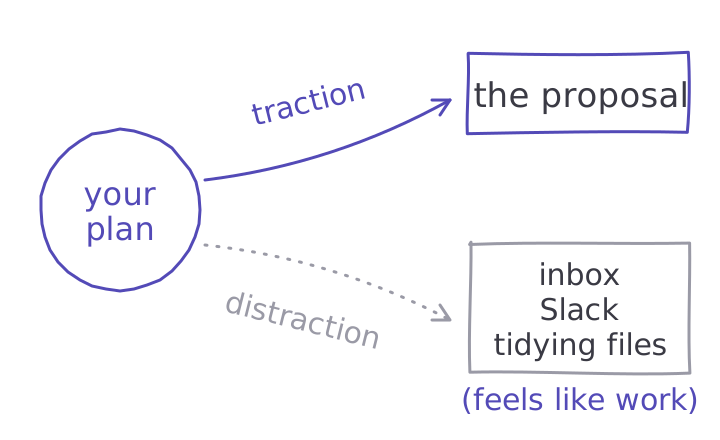
Nir Eyal, who writes about behaviour and focus, puts it simply. Traction is anything that pulls you toward what you want. Distraction is anything that pushes you away from it. In his words: "You can't call something a 'distraction' unless you know what it is distracting you from."
That flips the usual question. Answering emails at 9am is fine if 9am was for email. The same emails are a distraction if 9am was for the proposal. The activity tells you very little. The plan tells you everything.
It works the other way too. A planned break to read the news isn't a failure. You chose it.
Often, the interruption starts with you
It's tempting to blame the outside world: the phone, the pings, the colleague with "just a quick question".
Those are real. But when researchers at the London School of Economics filmed everyday phone use, 89% of pickups were started by the person, not by a notification.
Work looks similar. Laura Dabbish, Gloria Mark and Víctor González tracked over 5,000 task switches by people at work. Almost as many came from people interrupting themselves as from others interrupting them. And each extra outside interruption made people interrupt themselves more in the hour after.
So "what's distracting me?" is often the wrong question. It points at the phone, the inbox, the coworker. It rarely points at the plan, which is the one part you control.
Ask one question instead
Swap "what's distracting me?" for "what did I plan to do?"
That only works if there's an answer. So write the plan down before the day starts, with a time on it. A review of 94 studies by Peter Gollwitzer and Paschal Sheeran found that plans spelling out when, where and how you'll act had a medium-to-large effect on actually doing it. The full method is in time blocking.
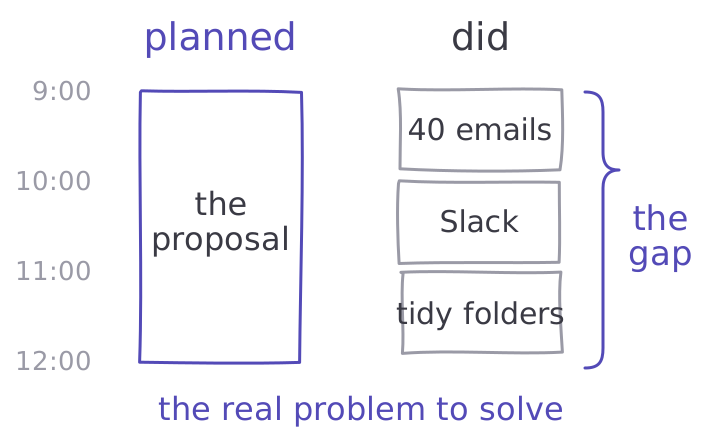
Then, during the day, compare. What did I plan? What am I doing right now? If they match, carry on, even if it's email. If they don't, you've found the gap.
When you find the gap
The gap is useful because it's specific. Not "I'm bad at focus", but "I planned the proposal and opened my inbox at 9:12."
Now ask what you felt just before you switched. Usually it's something uncomfortable: the task felt boring, unclear or a bit scary. Fuschia Sirois and Timothy Pychyl describe procrastination as a way to feel better right now, at the cost of your future self. Busy work is just the respectable version. More in how to stop procrastinating.
That moment is what CatchScroll is built for. When the urge to escape hits, you tap what you feel and get a two-minute reset made for it. Then you go back to the thing you planned.
You can set this up tonight in ten minutes. Write down tomorrow's one important task with a start time: "9:00, draft the proposal". Under it, write the busy work it usually turns into, and give that its own slot later in the day. Then set one check-in for 10:00. When it goes off, ask: "Is this what I planned?"
So before tomorrow starts: what's the one thing you planned, and what busy work is it most likely to turn into?
Try it
Make the plan. Then let CatchScroll catch the moment you drift: a focus timer that is free for good, and two free resets a week for when busy work starts to look tempting.
Try a reset free →Sources
- 01Eyal, N. — The 4 steps to becoming indistractable: internal triggers first, precommitments last. nirandfar.com ↗
- 02Heitmayer, M. & Lahlou, S. — Smartphone use is initiated by the user in 89% of interactions. Computers in Human Behavior, 2021 ↗
- 03Dabbish, L., Mark, G. & González, V. — Why do I keep interrupting myself? 5,089 observed task switches: 22% from external interruptions, 18% self-interruptions. CHI Conference on Human Factors in Computing Systems, 2011 ↗
- 04Gollwitzer, P. M. & Sheeran, P. — Implementation intentions and goal achievement: a meta-analysis of 94 tests (d = .65). Advances in Experimental Social Psychology 38, 69–119, 2006 ↗
- 05Sirois, F. & Pychyl, T. — Procrastination and the priority of short-term mood regulation. Social and Personality Psychology Compass 7(2), 115–127, 2013 ↗