How to do hard things at work: read the discomfort differently
The bad feeling isn’t a stop sign. Often it means you picked the right task.
6 October 2026 · 4 min read
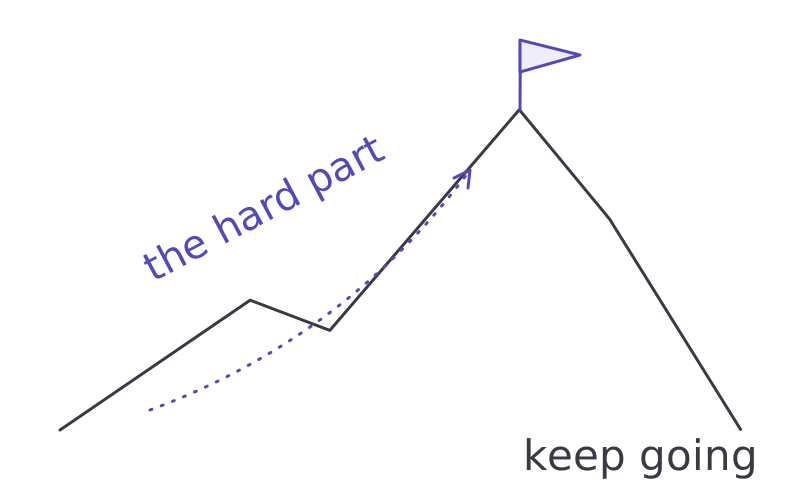
You open the pricing doc. Within a minute your chest tightens, and your hand is already on Slack.
Nothing is wrong with you. The task is hard, and hard feels bad. The real question is what you decide that bad feeling means.
The feeling arrives first
Hard work has a timing problem. The discomfort shows up in the first minute. The reward shows up weeks later, when the new pricing is live or the client signs.
So in the moment, the feeling wins. Psychologists Fuschia Sirois and Timothy Pychyl describe putting work off as a way to feel better right now, at the cost of your future self. You're not avoiding the task. You're avoiding the feeling.
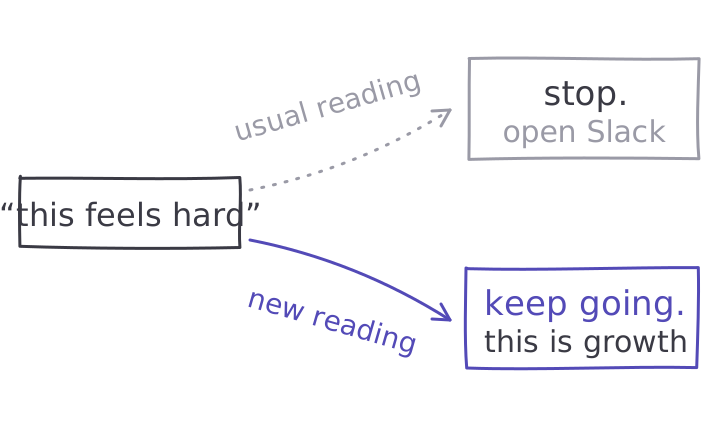
And most of us read that feeling the same way: this is going badly, stop.
Discomfort can be a signal to keep going
Kaitlin Woolley and Ayelet Fishbach tested a different reading. In five experiments with 2,163 adults, they asked some people to look for discomfort on purpose, and to treat it as a sign they were growing.
The tasks weren't office work. They were things like improv classes, writing about difficult feelings, and reading views people disagreed with. But they share the pattern of hard work: they feel bad straight away and pay off later.
People who saw discomfort as a sign of growth stuck with the task more, and felt they'd achieved more, than people given the usual instructions. One detail matters: it only worked where the discomfort came right away. That's exactly the kind you feel when you open the pricing doc.
The feeling didn't change. What it meant did.
Not every hard thing is worth it
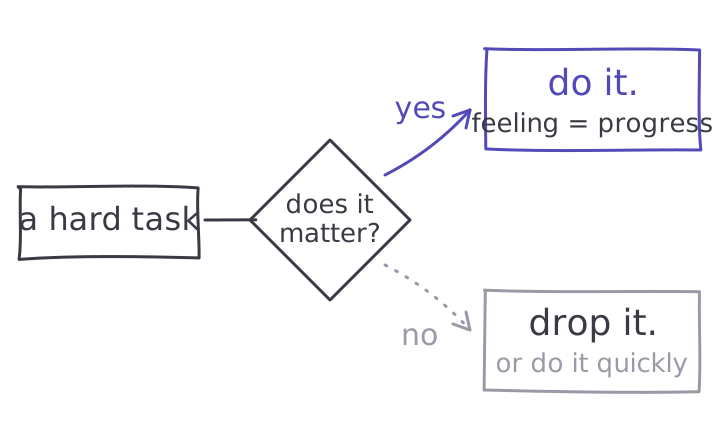
This isn't a case for doing everything that feels bad. Some tasks are hard and pointless: the report nobody reads, the meeting you could skip, the perfect slides for an internal update.
So before you push through, ask one question: does this matter for the work, the business or your career? If yes, read the discomfort as progress. If no, drop it, hand it off, or do the quick version.
Discomfort tells you a task is hard. It can't tell you it's worth doing. That part is your call.
When the feeling hits mid-task
It will come back, often just as the easy part runs out. That's when Slack, email and your phone look most inviting, and when busy work starts to look like real work.
Try three small steps. Name the feeling: "I'm stuck", "I'm unsure", "this is boring". Remind yourself what it means: you've reached the hard part, which is the part that counts. Then do one more small piece before you decide anything.
If the feeling is too strong to talk yourself through, that's what CatchScroll is for. You tap what you feel and get a two-minute reset made for it, then go back to the task. More ways to get unstuck are in how to stop procrastinating.
You can start today. Pick the one task you keep circling, the one you'd be relieved to have done. Write one line on what it makes you feel, and under it: "This feeling means I'm on the right task." Then give it ten minutes before you open email or your phone.
So: what's the hard thing on your list today, and what will you tell yourself when it starts to feel hard?
Try it
Pick the hard thing. Then let CatchScroll help you stay with it: a focus timer that is free for good, and two free resets a week for the moments the feeling gets loud.
Try a reset free →Sources
- 01Sirois, F. & Pychyl, T. — Procrastination and the priority of short-term mood regulation. Social and Personality Psychology Compass 7(2), 115–127, 2013 ↗
- 02Woolley, K. & Fishbach, A. — Motivating personal growth by seeking discomfort. Five experiments, 2,163 adults. Psychological Science 33(4), 510–523, 2022 ↗