Urge surfing: you don’t have to make the urge go away
The technique doesn’t shrink the urge. It changes what you do while it’s there.
8 October 2026 · 4 min read
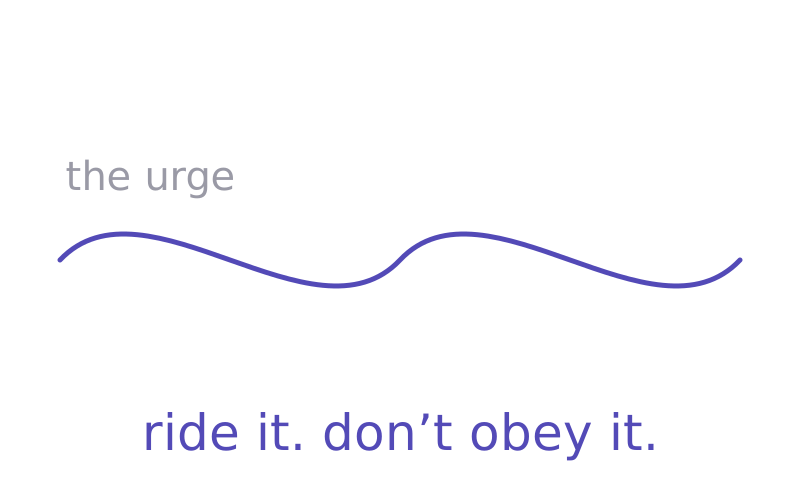
The report is half done. Your hand is already moving toward your phone, and you haven’t decided anything.
Most advice says: resist. Push it down. Win. That rarely lasts, because it treats the urge as an enemy you have to beat every single time.
Urges are normal, and constant
Wilhelm Hofmann and his team gave 205 adults a beeper for a week. Each time it went off, people reported whether they were feeling a desire right then, and what they did about it. They collected 7,827 reports.
Desires turned out to be frequent, they varied a lot in strength, and most of them caused no problem at all. The ones that clashed with a goal, like checking your phone in the middle of a report, people tried to resist, with mixed success.
At work they look familiar: the second coffee, the inbox, the news tab, the phone.
So the aim can't be to stop having urges. You'll have plenty today. The question is what happens in the seconds after one arrives.
Riding the wave
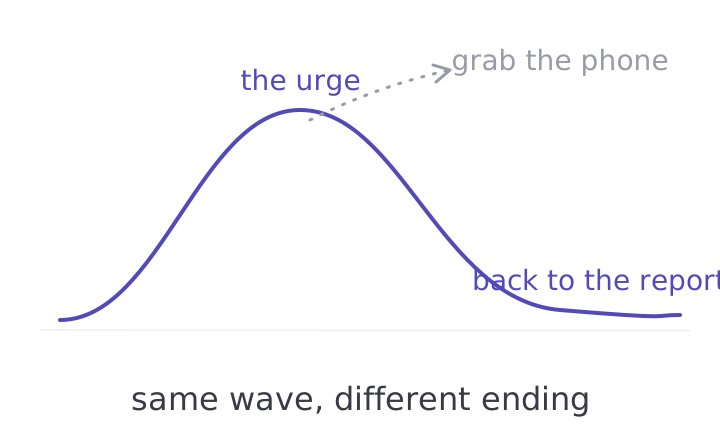
Urge surfing comes from the psychologist Alan Marlatt, who worked on addiction. The idea is to treat an urge like a wave. You don't fight it and you don't follow it. You notice it rise, feel it in your body, and stay with it until it passes.
Think of the last meeting where you wanted to check your phone but couldn't. The pull was strong for a minute. By the end of the meeting you'd forgotten it.
It sounds too simple to work. So it's worth looking at what happened when someone tested it.
What the study actually found
Sarah Bowen and Alan Marlatt worked with 123 students who smoked and wanted to cut down. In the lab, they were exposed to smoking cues designed to trigger a strong urge. Half got short instructions in urge surfing. Half got none.
The urges were no different between the groups. Urge surfing didn't make the craving any weaker.
But over the next seven days, the urge-surfing group smoked significantly fewer cigarettes.
That's the whole point. The urge stayed just as strong. What changed was the gap between feeling it and acting on it. It also means you don't have to feel calm to succeed. You can want the phone badly and still not pick it up. Cigarettes aren't phones, of course. But the pattern is one you know from your desk: a strong pull, and a hand that moves before you've chosen.
How to surf an urge at your desk
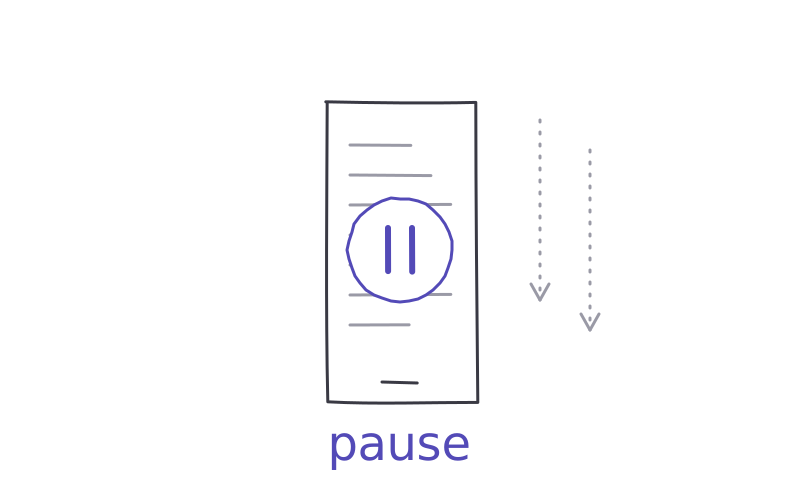
Next time you notice the reach, stop your hand where it is. Don't put the phone away in a hurry, and don't pick it up. Just pause.
Name it: "There's the urge." Then find it in your body. A tight chest, restless hands, a pull behind the eyes. Rate how strong it is from 1 to 10.
Breathe, and watch it for a minute. Check the number again. It may rise first. Let it. You're not trying to make it go away. You're just not obeying it yet.
Then decide. If you still want the phone, fine. But now it's a choice, not a reflex. Most of the time you'll find you'd rather finish the paragraph.
Practise when the stakes are low. Try it on the urge to check email while a file loads, or while a page refreshes. Small waves first. If the same urge keeps coming back at the same moment, look at the feeling under it: why we doomscroll covers the usual ones.
So next time your hand moves first: don't fight it. Watch it.
Try it
You don’t have to win against every urge. CatchScroll gives you a two-minute reset for the feeling behind the pull, then sends you back to the work, with a focus timer that is free for good.
Try a reset free →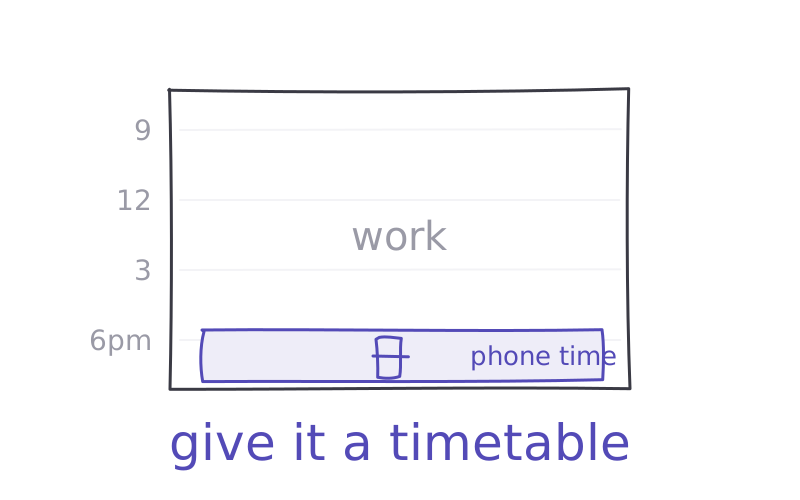
Sources
- 01Hofmann, W., Baumeister, R. F., Förster, G. & Vohs, K. D. — Everyday temptations: an experience sampling study of desire, conflict and self-control. 205 adults, 7,827 reports. Journal of Personality and Social Psychology 102(6), 1318–1335, 2012 ↗
- 02Bowen, S. & Marlatt, A. — Surfing the urge: brief mindfulness-based intervention for college student smokers. 123 participants. Psychology of Addictive Behaviors 23(4), 666–671, 2009 ↗