Bored at work? Your boredom is telling you one of three things
Boredom isn’t a lack of discipline. It’s a signal, and each kind needs a different fix.
8 October 2026 · 4 min read
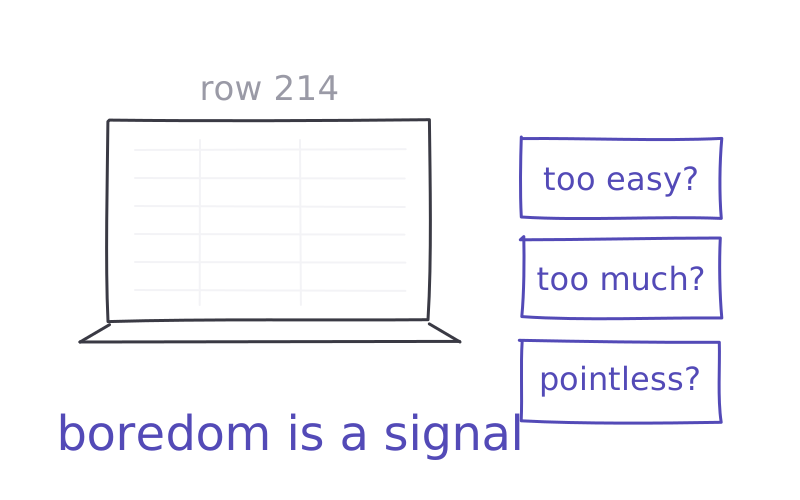
Row 214 of the spreadsheet. Same columns, same checks, 300 rows to go.
You haven’t decided to pick up your phone. Your hand already has.
We’d rather do almost anything
Boredom feels small, but it's surprisingly powerful.
Timothy Wilson and his team at the University of Virginia asked people to sit alone in a room for a few minutes with nothing to do but think. Most didn't enjoy it. In one study, they could give themselves an electric shock if they wanted to. 67% of men and 25% of women did, at least once.
Plenty of people chose pain over doing nothing.
Your phone is much nicer than an electric shock, and it's always within reach. So when work gets dull, the reach isn't a character flaw. It's what humans do with an empty minute.
It's also why boredom rarely looks like boredom. It looks like "quickly checking" Slack, refilling your coffee, or tidying your inbox for the third time.
Boredom is a signal
The usual advice is to push through. But boredom isn't random. It's telling you something specific.
Psychologists Erin Westgate and Timothy Wilson describe boredom as a sign that your attention isn't properly engaged in something that matters to you. In their model, it comes from two kinds of mismatch.
Attention. The task doesn't fit the mental energy you have. It can be too easy, so your mind wanders off. Or it can be too much, so your mind gives up. Both feel like boredom.
Meaning. The task doesn't connect to anything you care about. You can't see why it matters, so your brain won't commit to it.
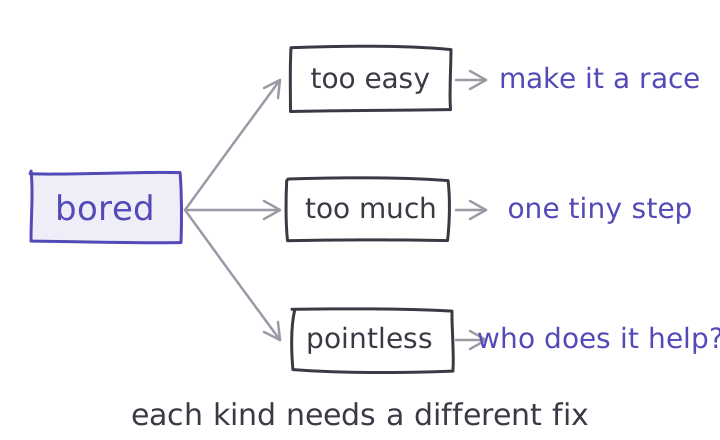
That gives you three kinds of bored at work: too easy, too much, or pointless. Too easy is row 214. Too much is the 40-page report you've opened five times. Pointless is the status update you suspect nobody reads. And each one needs a different fix.
Why the phone doesn’t fix it
The phone gives you stimulation, so for a moment the boredom goes away. But it fixes none of the three causes.
The spreadsheet is still too easy. The report is still too big. The task still feels pointless. You come back to exactly the same work, only later, and a little more tired. And the break costs you more than it seems: in a study of 414 people by Kang and Kurtzberg, those who took a break on their phone solved fewer problems afterwards than those who took the same break on paper or a computer.
So the question isn't "how do I stop being bored?" It's "which kind of bored is this?"
Read the signal, then fix it
Next time you notice the reach, stop and ask which of the three it is. It usually takes a few seconds.
Too easy? Make it a race. "Twenty rows in ten minutes." Set a timer and try to beat it. It sounds childish. It works because it turns a task that asks nothing of you into one that asks a little, and gives your attention something to hold on to.
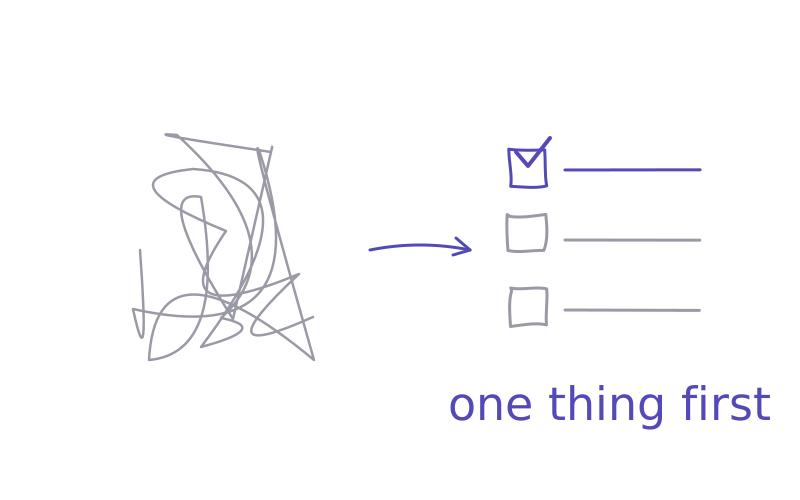
Too much? Shrink it. Write down the one next tiny step, like "open the file and write the first heading", and do only that.
Pointless? Write one line about who this helps or what it unlocks. "This report lets Sam decide the budget on Friday." If you honestly can't write that line, ask whether the task can be dropped, handed off, or done quickly. Some work really is pointless, and boredom is the first to notice.
If it's a dip that keeps coming back at the same time every day, why we doomscroll covers the other feelings that look like boredom from the outside. And if it feels less like boredom and more like you can't get going at all, read no motivation to work.
So: what's the most boring task on your list today, and which kind of bored is it?
Try it
Name the boredom, then fix the right thing. CatchScroll has a two-minute reset made for boredom, and a focus timer that is free for good, for the race against row 214.
Try a reset free →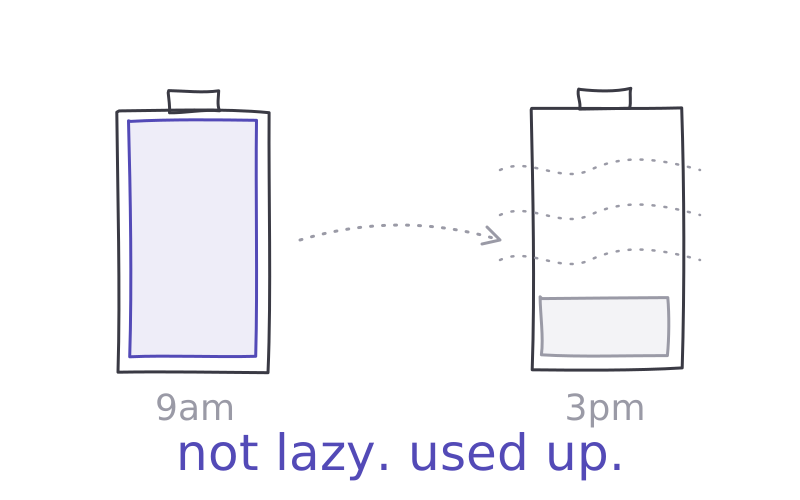
Sources
- 01Wilson, T. D. et al. — Just think: the challenges of the disengaged mind. 11 studies; 67% of men and 25% of women gave themselves at least one shock rather than sit with their thoughts. Science 345(6192), 75–77, 2014 ↗
- 02Westgate, E. C. & Wilson, T. D. — Boring thoughts and bored minds: the MAC model of boredom and cognitive engagement (attention and meaning). Psychological Review 125(5), 689–713, 2018 ↗
- 03Kang, S. & Kurtzberg, T. R. — Reach for your cell phone at your own risk: the cognitive costs of media choice for breaks. 414 participants. Journal of Behavioral Addictions 8(3), 395–403, 2019 ↗