How to focus with ADHD: the advice for everyone else may be backwards
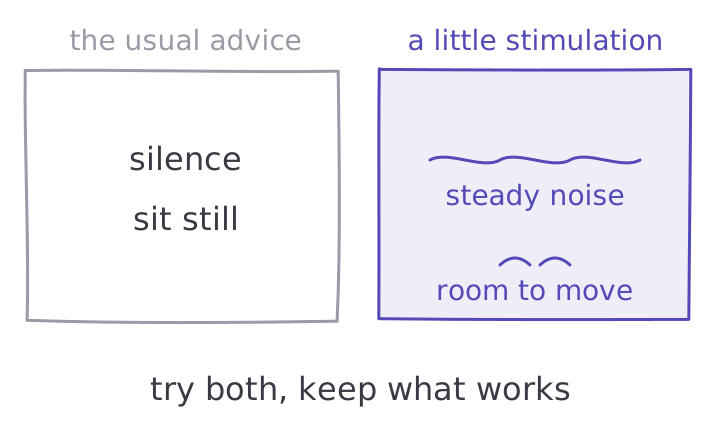
Silence and sitting still are standard focus advice. With ADHD, a little more stimulation may work better.
8 October 2026 · 4 min read
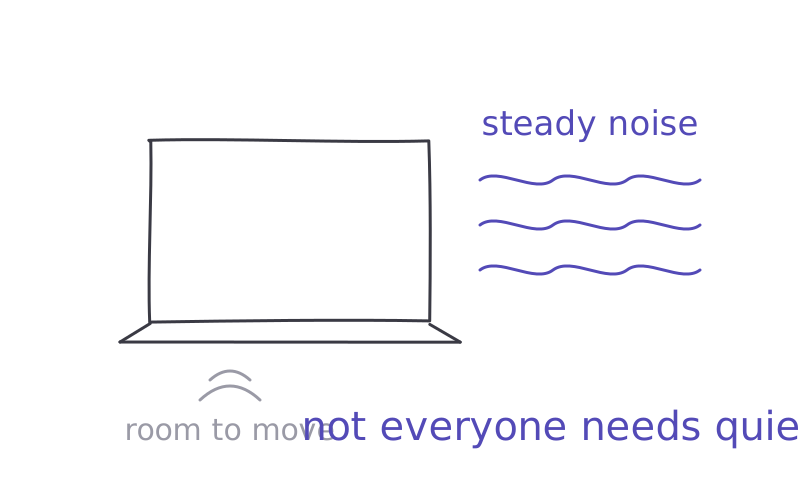
Your colleague works best in a silent room with the door shut.
You try it. Ten minutes in, you’ve tidied your desktop, checked your phone twice and opened a tab about something else entirely.
Same advice, opposite effect
Most focus advice is written for one kind of brain. Cut the noise. Sit still. Remove everything.
For a lot of people with ADHD, that quiet, still room doesn't feel calm. It feels empty, and the mind goes looking for something to fill it.
There's research that shows the split clearly. Joel Nigg and his team pooled the studies that tested white and pink noise during attention tasks. For young people with ADHD or strong ADHD symptoms, the noise gave a small boost. For people without ADHD, the same noise made scores slightly worse.
Same sound. Opposite result. So if the standard advice hasn't worked for you, that may not be a failure of effort. It may just be the wrong advice for your brain.
Moving may help, not hurt
The leg bouncing under your desk usually gets treated as a problem to fix.
A team led by T. A. Hartanto looked at it differently. Children and teenagers, some with ADHD and some without, wore a movement sensor on their ankle during an attention task. In the ADHD group, more intense movement went with more correct answers. In the group without ADHD, it didn't.
This was a small study of young people, and it shows a link, not proof. But it's a good reason to stop treating every fidget as the enemy. In a meeting, that might mean taking notes by hand or standing at the back. At your desk, a footrest you can push against.
So instead of fighting the fidget, it may be worth giving it somewhere to go.
Which noise has the evidence
Brown noise is the one everybody talks about online. It's also the one nobody has properly tested yet: Nigg's review didn't find a single study of it.
White and pink noise are the ones with evidence, and the effect was small. That matters. A sound won't fix a hard day on its own. But a small, steady help that costs nothing is worth a fair test. Keep the volume low: just loud enough to blur the voices around you.
There's more on the different noises, and how loud to play them, in brown noise for studying.
Set up your desk for your brain
Start with movement. Take calls standing or walking. Keep something under the desk your feet can push on, or something in your hand that doesn't need your eyes. If you can, try a standing desk for the first hour of the day.
Then test a sound properly. For one week, work with white or pink noise at a low volume. For one week, without. Each day, write down one number: how many focus blocks you finished. Let the number decide, not the hype.
Keep the blocks short. Fifteen minutes with a clear end is easier to start than an open afternoon. A focus timer with a sound built in does both jobs at once.
If you work in an office, ask for what helps: headphones at your desk, a seat away from the walkway, walking one-to-ones. Most of it costs nothing, and you don't need to share a diagnosis to ask.
These are small adjustments, not treatment. If ADHD makes work hard most days, a doctor can talk you through options that make a much bigger difference.
So for tomorrow: what would you change if you stopped trying to sit still?
Try it
Give your brain the setup it works best with. CatchScroll’s focus timer is free for good, with brown noise built in, and Pro adds white, pink and five more sounds, plus a coach for the days focus won’t come.
Try a reset free →
Sources
- 01Nigg, J. T. et al. — Do white noise or pink noise help with task performance in youth with ADHD? Meta-analysis of 13 studies, 335 participants; no studies of brown noise found. Journal of the American Academy of Child and Adolescent Psychiatry 63(8), 778–788, 2024 ↗
- 02Hartanto, T. A. et al. — More intense physical activity is associated with better cognitive control performance in ADHD. 44 children and teenagers aged 10–17. Child Neuropsychology 22(5), 618–626, 2016 ↗