Context switching: the quick check that drags half your mind away
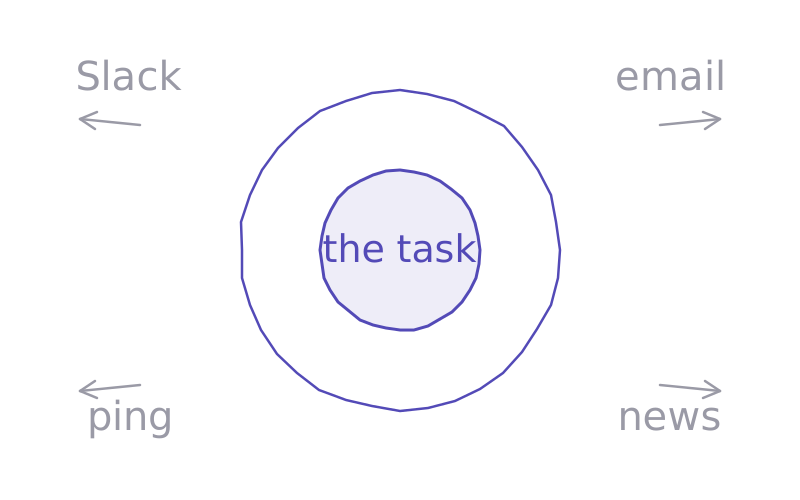
The switch takes seconds. The cost is the part of your attention that doesn’t come with you.
8 October 2026 · 4 min read
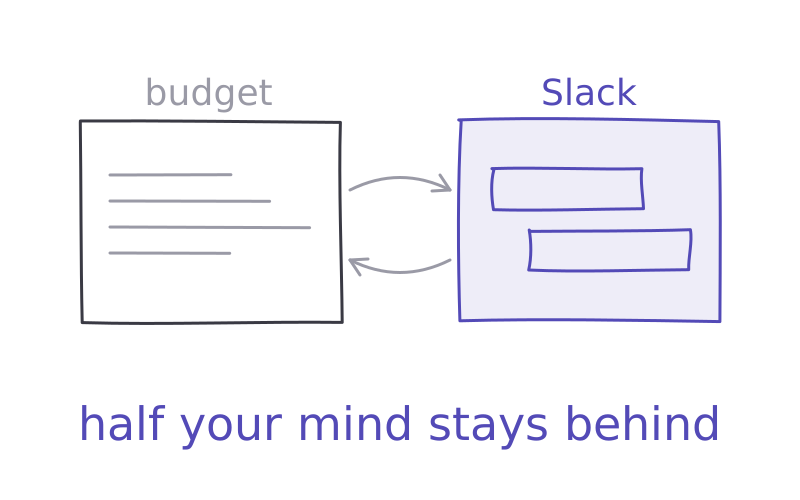
You’re halfway down the budget sheet. Slack pings: “Quick question about the client deck?”
You answer in forty seconds. Then you’re back at the sheet, reading the same row for the third time.
Every switch has a price
Switching feels free. One tab to another, done.
It isn't. Psychologists Joshua Rubinstein, David Meyer and Jeffrey Evans ran four experiments where people either repeated the same task or kept switching between two. Every switch cost time. The more complicated the task, the bigger the cost. And a clear signal of which task came next made the cost smaller.
One switch costs very little. But a normal workday has a lot of them: email, Slack, the doc, a call, back to the doc. The small costs add up to a day that felt busy and produced little.
And every switch has a return trip. Each time you come back to the budget, you have to find your place again.
Count yours tomorrow. Put a tick on a sticky note every time you jump to email, Slack or your phone. Most people are surprised by the total.
Both tasks get worse
There's a second cost, and it's sneakier.
Sophie Leroy and Theresa Glomb studied what happens to your attention when you get pulled away from unfinished work. When people knew they'd have to come back to the first task under time pressure, part of their mind stayed on it. Researchers call this attention residue.
Here's the twist. The residue didn't just hurt the work they came back to. It hurt the interruption too. People did worse on the second task, because half their mind was still on the first.
You've probably felt this. You reply to a colleague, hit send, and realise you answered a slightly different question from the one they asked.
So the forty-second Slack reply wasn't really forty seconds of your best thinking. It was forty seconds of half of you, while the budget sat open in the back of your head.
Plan the way back first
Leroy and Glomb also tested a fix, and it's tiny.
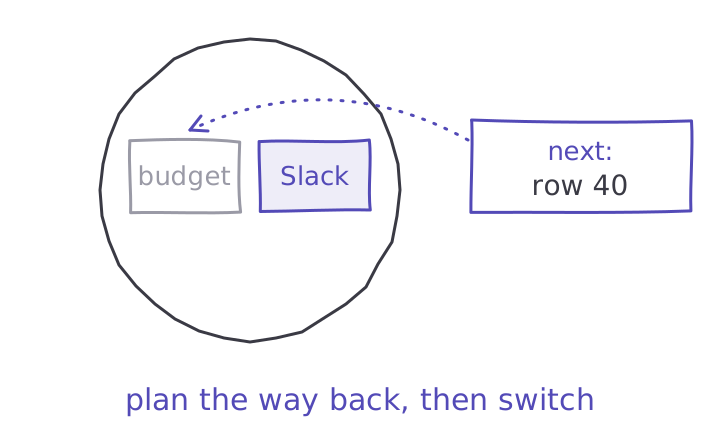
Before switching, some people took a moment to reflect on the task they were leaving and plan how they'd return to it. That was all. Across four studies, this ready-to-resume plan cut the attention residue, and their performance on the interruption no longer suffered.
A simple way to see it: your mind keeps hold of unfinished work so it doesn't get lost. Write down where you'll pick up, and it can let go. The same goes for quick replies mid-task: the two-minute rule covers when to do them and when to list them.
The note doesn't need to be neat. "Row 40, check the invoice total" is enough. Nobody else will read it.
Switch less, and switch cleanly
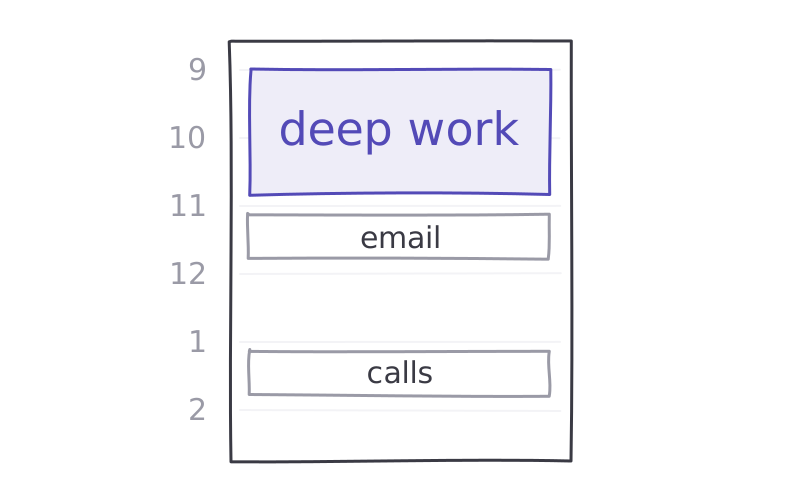
First, switch less. Pick set times for Slack and email, like ten minutes on the hour, instead of answering each ping as it lands. Most messages can wait fifty minutes. More on handling the pings is in how to stay focused at work.
Second, when you do switch, take twenty seconds first. Write one line: "Next: check row 40 against the invoice." Leave it on top of the document, where you'll see it when you return.
Third, give each task one clear signal. One window, full screen. Close the tabs that belong to other work. Rubinstein's study found a clear cue shrinks the switching cost, and a screen that shows only one job is about as clear a cue as you can give yourself.
And when a switch really can't wait, like your manager at your desk, say "give me one minute", write your line, then turn around.
So: what will you write down before your next switch?
Try it
Switch on purpose, not on reflex. CatchScroll’s focus timer gives each task one clear block, free for good, and a two-minute reset for the moments the pull to switch gets loud.
Try a reset free →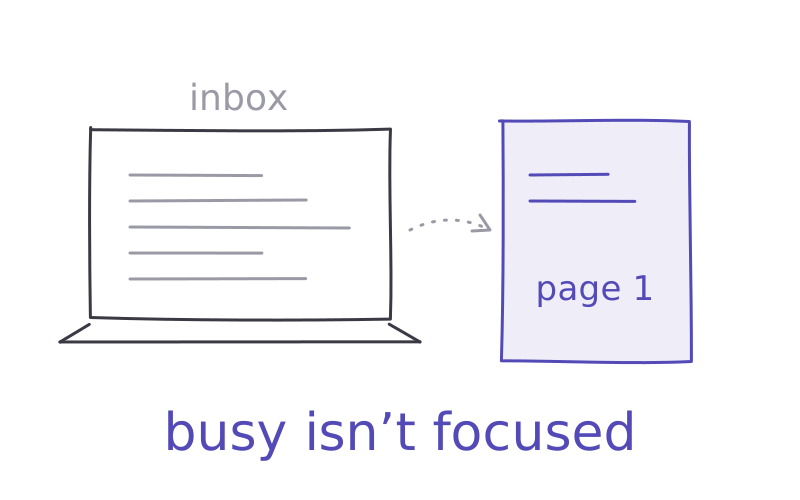
Sources
- 01Rubinstein, J. S., Meyer, D. E. & Evans, J. E. — Executive control of cognitive processes in task switching. Four experiments. Journal of Experimental Psychology: Human Perception and Performance 27(4), 763–797, 2001 ↗
- 02Leroy, S. & Glomb, T. M. — Tasks interrupted: attention residue and how a “ready-to-resume” plan mitigates the effects. Four studies. Organization Science 29(3), 380–397, 2018 ↗