Eat the frog: it works, but most people pick the wrong frog
Doing the hardest task first is good advice. The hard part is choosing the frog, and when you choose it.
17 October 2026 · 4 min read
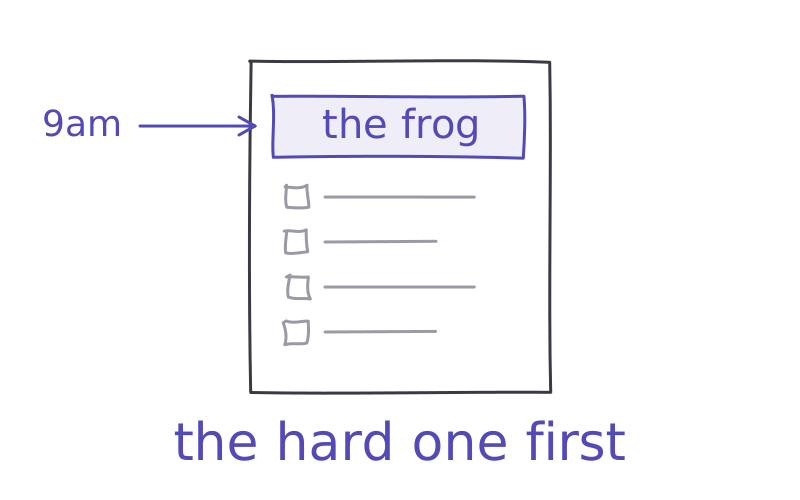
8:55. Coffee in hand, you open the to-do list to find your frog.
Twenty minutes later you’ve “eaten” three emails and a calendar invite, and the real frog is still sitting at the bottom of the list.
A toad, not a productivity tip
"Eat a live frog first thing in the morning, and nothing worse will happen to you the rest of the day." The line is usually credited to Mark Twain.
He almost certainly didn't say it. Quote Investigator traced it back to the French writer Nicolas Chamfort in the 18th century, and his version was about swallowing a toad each morning to cope with the disgust of high society. It was first tied to Twain in 1988, decades after he died.
The productivity version comes from Brian Tracy's book Eat That Frog! For Tracy, your frog is your biggest, most important task, the one you're most likely to put off. Do it first, and the rest of the day is easier.
The idea is good. It's worth knowing why it works, because that's also why it so often fails.
Why first really is better
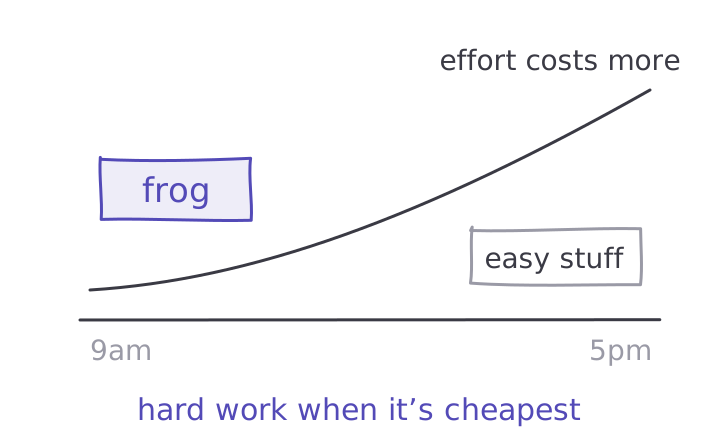
It's not just a matter of getting it out of the way. Your brain changes over the day.
A team at the Paris Brain Institute led by Antonius Wiehler and Mathias Pessiglione had people do mentally hard work for most of a day. By the end, a chemical linked to hard thinking had built up in a brain region used for self-control. And their choices changed: they started picking options that took less effort and paid off sooner.
In other words, effort gets more expensive as the day goes on. By 3pm, the same frog costs more than it did at 9am. Do it first, while it's cheapest.
That's the half of the advice most people follow. The other half is where they go wrong.
Three ways to pick the wrong frog
Choosing it in the morning. At 8:55, you're picking the frog with the same brain that wants to avoid it. So you choose something that feels hard but isn't really the one: the awkward email, not the proposal. If you're going to decide, decide before the morning arrives.
Picking a frog that's too big. "The strategy" isn't a frog. It's a pond. A frog is something you can finish, or make real progress on, in one sitting of 60 to 90 minutes. If it's bigger, the frog is its first chunk.
Keeping a few frogs. Tracy is clear on this: if you have two frogs, start with the biggest, hardest one. One frog at a time. The rest of the list can wait until after.
And the unpleasant frog isn't always the important one. Calling a supplier about a late invoice is unpleasant. Writing the pitch that wins the next client is important. When they're different, the important one is the frog.
How to eat it tomorrow
Tonight, before you close your laptop, take five minutes.
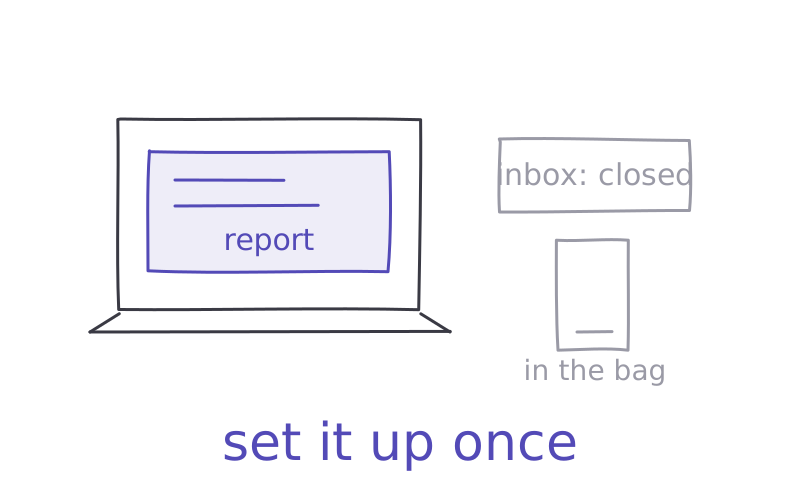
Name tomorrow's frog. Ask: "Which task, if I did only this, would make tomorrow a good day?" Write it on a sticky note and put it on your keyboard.
Cut it to one sitting. Rewrite it as a chunk you can finish in 60 to 90 minutes. "Draft the first two sections of the pitch," not "the pitch".
Give it a time. "At 9:00, before I open email, I open the pitch doc." A review of 94 studies by Peter Gollwitzer and Paschal Sheeran found that plans spelling out when, where and how you'll act had a medium-to-large effect on actually doing it. The full method is in time blocking.
Leave the inbox shut until the frog is done, or until the time is up. If you open email first, the day decides for you.
If your best hours aren't in the morning, that's fine. Eat the frog at the start of your sharpest block, whenever it is. The rule is "hardest first", not "9am or bust".
So, before you close the laptop tonight: what's tomorrow's frog?
Try it
When the frog makes you reach for your phone, CatchScroll catches the moment: a two-minute reset for the feeling behind the urge, then back to the frog, with a focus timer that is free for good.
Try a reset free →
Sources
- 01Quote Investigator — Eat a live frog every morning: no substantive evidence Mark Twain said it; it grew from a Chamfort line about swallowing a toad each morning “to fortify ourselves against the disgust of the rest of the day.” First tied to Twain in 1988. quoteinvestigator.com, 2013 ↗
- 02Tracy, B. — The truth about frogs: your frog is “your biggest, most important task,” the one “you are most likely to procrastinate on.” briantracy.com ↗
- 03Wiehler, A., Branzoli, F., Adanyeguh, I., Mochel, F. & Pessiglione, M. — A neuro-metabolic account of why daylong cognitive work alters the control of economic decisions: higher glutamate in the lateral prefrontal cortex after high-demand work. Current Biology 32(16), 2022 ↗
- 04Gollwitzer, P. M. & Sheeran, P. — Implementation intentions and goal achievement: a meta-analysis of 94 tests (d = .65). Advances in Experimental Social Psychology 38, 69–119, 2006 ↗