Self-discipline isn’t willpower. Disciplined people just fight less
The people you admire for their discipline aren’t stronger. They’ve arranged things so they rarely need to be.
8 October 2026 · 4 min read
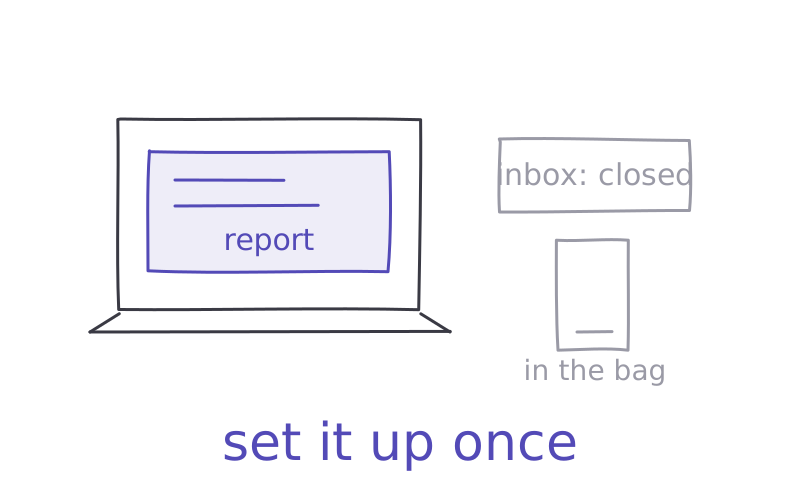
You promised yourself: no email until the report is done.
9:04am. The report is open in one tab and your inbox is open in the other. You don’t remember clicking it.
The picture we have of discipline
Ask most people what self-discipline looks like and they describe a fight. Jaw set. Temptation right there. You win by refusing, again and again.
Think of the colleague who always has the report in early. You probably assume they have more willpower than you. Have you ever actually seen them battle their inbox?
If that were true, the most disciplined people would be the ones resisting hardest all day long.
The research says the opposite.
They fight less, not harder
Brian Galla and Angela Duckworth ran six studies with 2,274 people. They started from a puzzle: people with strong self-control actually report less effortful resisting in daily life, not more. So how do they get so much done?
Their answer was habits. People with better self-control had stronger habits, for exercise, for sleep, for study. Those habits explained why they reached their goals while fighting themselves less. With a habit in place, the behaviour ran more on autopilot and needed less effort to push through.
The discipline wasn't in the moment of temptation. It was in a routine that made the moment rare. Willpower is still there for emergencies. It just isn't doing the daily work.
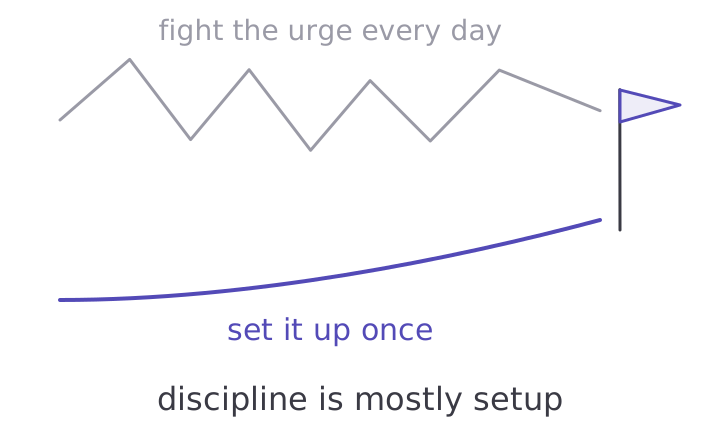
Change the room, not yourself
Angela Duckworth, Tamar Gendler and James Gross looked at the other half of the story: the situation.
Their examples are ordinary. The partygoer who sits far from the drinks. The student who goes to the library without a phone. These people don't win the fight. They make sure it never starts, by choosing or changing the situation before the urge gets strong.
They also point out why we underrate this. It works because it removes the struggle, and without the struggle it doesn't feel like discipline. So we give the credit to willpower instead.
At work, the room is mostly your screen. An open inbox is a temptation sitting in plain sight. A closed one is a decision you made once, earlier, when it was easy.
The same goes for your phone. On the desk, every buzz is a small fight. In a bag across the room, there's nothing to resist. And a meeting-free morning set once in your calendar beats one you defend every day.
Build one habit this week
Start with one moment, not your whole day. One habit that sticks beats five that last a week.
Pick the moment you lose most often. For many people it's the first hour: the plan is deep work, the reality is email.
Set up that moment the night before. Close the inbox and Slack. Leave tomorrow's first task open on the screen, at the exact line where you'll start. Put your phone in your bag, not on the desk. If you work from home, the room can be literal: a desk that's only for work, and a different chair for scrolling.
Then repeat it at the same time and in the same place every day, so it turns into a habit and stops being a decision. Time blocking shows how to protect that first slot.
And when you slip, change the setup, not your opinion of yourself. A slip just shows you where the room still has a door open. For the moments a pull still breaks through, urge surfing helps you ride it out.
So: where do you lose the fight most often? Change that room first.
Try it
Make the good choice the easy one. CatchScroll gives your first hour a focus timer that is free for good, and a two-minute reset for the moments the pull still gets through.
Try a reset free →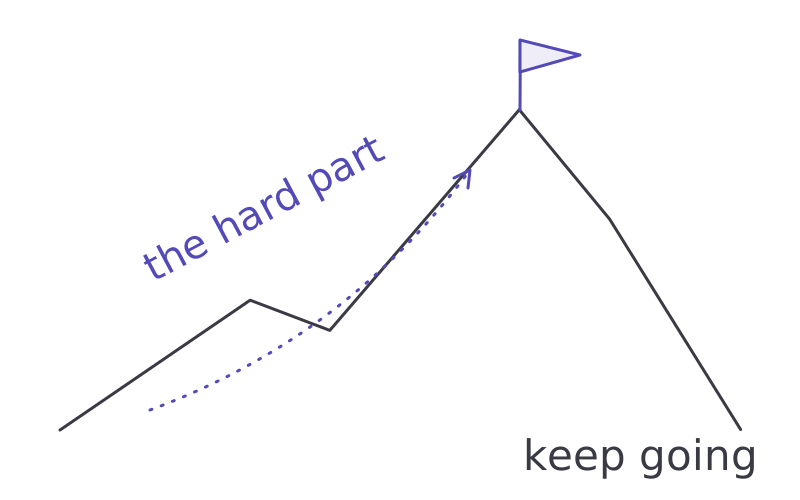
Sources
- 01Galla, B. M. & Duckworth, A. L. — More than resisting temptation: beneficial habits mediate the relationship between self-control and positive life outcomes. Six studies, 2,274 people. Journal of Personality and Social Psychology 109(3), 508–525, 2015 ↗
- 02Duckworth, A. L., Gendler, T. S. & Gross, J. J. — Situational strategies for self-control. Perspectives on Psychological Science 11(1), 35–55, 2016 ↗