Focus music for work: the best kind is the one you barely notice
Your favourite album is great for your mood. For hard work, it may be the worst thing on your playlist.
17 October 2026 · 4 min read
Headphones on. Your favourite album, the one you know every word of. You’re ready to write the report.
An hour later you know every word of the album again. The report has two paragraphs.
Your favourite music is the problem
It feels backwards. Music you love should make work feel better, and it does. But feeling better and focusing better aren't the same thing.
Researchers Huang and Shih played different kinds of background music to 89 workers while they did an attention test, and asked how much they liked each one. The type of music mattered less than how people felt about it. The more someone liked or disliked the music, the more it got in the way of their attention compared with silence.
One likely reason: music you love pulls you in. You sing along in your head, you wait for the good bit, you remember where you were when you first heard it. All of that uses the attention your work needed.
Music you hate does the same, just less pleasantly.
Words fight words
Lyrics are the second problem. In a randomised trial with 102 people, Shih and colleagues found that background music with lyrics hurt concentration and attention. Music without lyrics didn't do the same damage.
It's worst when your work is made of words too. A 2026 review of 30 studies found that background speech slows reading, and speech you can understand does the most damage. A song in your language is speech you can understand, set to a beat.
So if you're writing, reading or editing, a singer is competing with your work for the same attention. That's why the same playlist can feel fine while you sort files and impossible while you edit a contract. The task changed, not the music.
But music still earns its place
None of this means silence is always best.
Teresa Lesiuk followed 24 software developers for three weeks: a week with music, a week without, then music again. In the music weeks, they listened to music they liked, whenever they wanted. They said their mood and their work were better in those weeks.
So music is a tool. Your favourites lift your mood, which helps with dull work and low moments. Quiet, steady sound protects your attention on hard work. The trick is to use the right one at the right time, on purpose.
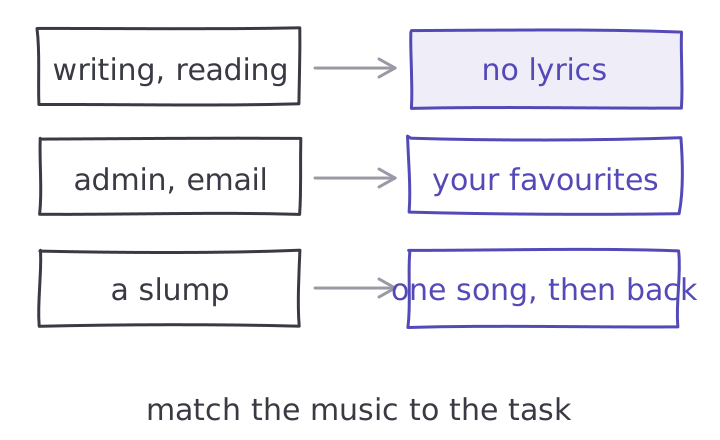
What to play, and when
For hard work with words (writing, reading, analysis, careful email): no lyrics, and nothing you love or hate. Lo-fi, ambient, film scores, quiet piano, or a steady sound like brown noise or rain. Keep the volume low enough that you'd hear someone say your name. If people are talking nearby, a steady sound also helps blur their voices, as we explain in brown noise for studying.
For routine work (admin, filing, data entry, tidying the inbox): this is where your favourite playlist belongs. Lyrics are fine. The lift in mood is worth more than the lost attention, because the task doesn't need much.
For a slump: play one song you love, all the way through, as a break. Then switch back to your focus sound and start again.
Keep one focus sound for deep work. Use the same one every time you start hard work, so pressing play becomes the start of the block.
Not sure what works for you? Test it. Do your hardest block with your focus sound one day and with your favourite playlist the next, then compare what you actually finished. Your own results beat any rule of thumb.
So what's in your headphones right now, and does it fit the task in front of you?
Try it
Our free focus timer plays brown noise with a countdown, no sign-up. CatchScroll Pro adds rain, lo-fi and more, plus a two-minute reset for the moment the urge to scroll wins.
Play brown noise with a timer →
Sources
- 01Huang, R.-H. & Shih, Y.-N. — Effects of background music on concentration of workers. Randomised trial, 89 workers: the effect on attention depended more on how much people liked or disliked the music than on its type. Work 38(4), 383–387, 2011 ↗
- 02Shih, Y.-N., Huang, R.-H. & Chiang, H.-Y. — Background music: effects on attention performance. Randomised trial, 102 people: music with lyrics had significant negative effects on concentration and attention. Work 42(4), 573–578, 2012 ↗
- 03Guan, Y. et al. — The irrelevant speech effect in reading: a meta-analysis of 30 studies. Cognitive Processing, 2026 ↗
- 04Lesiuk, T. — The effect of preferred music on mood and performance in a high-cognitive demand occupation. 24 software developers over 3 weeks: self-reported mood and performance improved in the music weeks. Journal of Music Therapy 47(2), 137–154, 2010 ↗