Your attention span isn’t broken. It’s trained.
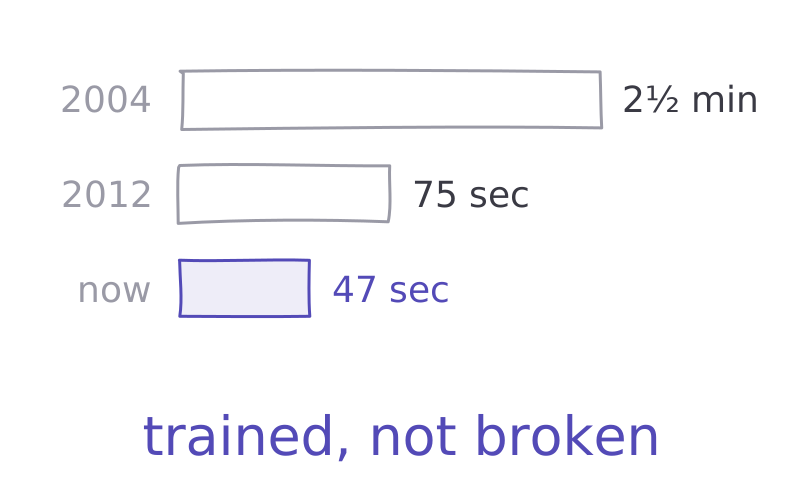
The average stretch on one screen is down to 47 seconds. What was trained can be trained back.
12 October 2026 · 5 min read
You open the report. You read a line. Then you’re in your inbox, then on your phone, then back at the report, wondering where ten minutes went.
It’s easy to decide your attention span is just short now. Ruined, maybe. It isn’t. It’s doing exactly what you’ve trained it to do.
From two and a half minutes to 47 seconds
Gloria Mark, a professor at the University of California, Irvine, has spent about twenty years timing how long people stay on one screen before they switch.
In 2004, the average was two and a half minutes. Around 2012, it was 75 seconds. In recent years it has averaged about 47 seconds, and half of all the measurements were 40 seconds or less.
You may also have heard that we now have a shorter attention span than a goldfish: eight seconds. That one isn't real. When the BBC traced it, the figure led back to a website whose source nobody could find.
Mark's numbers are real. But look at what they measure. Not a damaged brain. Switching.
Every switch is practice
Most of us blame notifications. They're part of it. But in one study of 5,089 task switches at work, 22% came from outside interruptions and 18% were people interrupting themselves. Almost as many, with nothing pulling them away.
Phones are even more lopsided. In a study of everyday smartphone use, 89% of the times people used their phone, they picked it up themselves. No buzz, no ping.
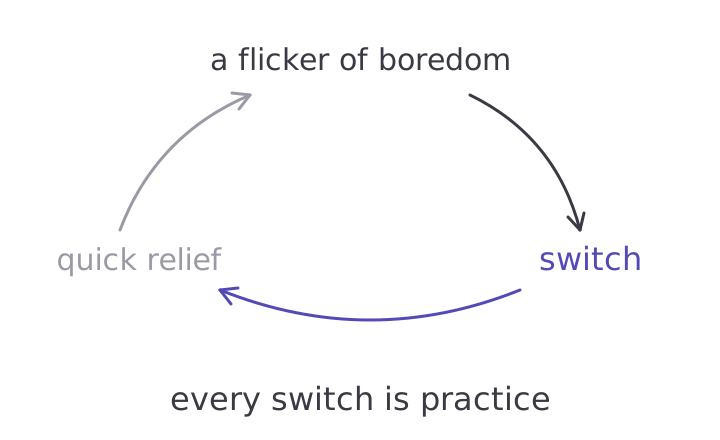
Here's how it goes. The work gets a little boring, a little hard, a little unclear. You switch. The feeling goes away for a moment. That small relief is what makes the next switch easier to reach for.
Do that dozens of times a day, for years, and a 47-second average stops being surprising. You've practised it.
Wandering is normal. Coming back is the skill
Even without a screen, your mind drifts. Matthew Killingsworth and Daniel Gilbert used an iPhone app to check in with 2,250 people at random moments. On average, their minds were somewhere other than what they were doing 46.9% of the time.
So a longer attention span doesn't mean a mind that never wanders. It means noticing sooner, and coming back more often.
That can be trained. In a randomised study, Michael Mrazek and colleagues gave people a two-week mindfulness course. Afterwards their minds wandered less during tests, and their scores on a reading-comprehension test and a working-memory test went up.
Two weeks is not long. The same practice works at a desk: notice the drift, name it, return.
How to improve your attention span
Start with a block you can win. Pick one task, close every window it doesn't need, and put your phone out of reach. Twenty minutes, not two hours. Finishing short blocks teaches you that you can.
When the flicker comes, and it will, don't switch straight away. Notice it, name the feeling ("bored", "stuck", "anxious"), take one slow breath, and go back to the line you were on. That's one repetition. Our guide to urge surfing goes deeper.
When you do need to switch, stop at a natural break, and write one line about where you'll pick up. It helps your mind let go of the first task. Context switching explains why.
Take real breaks between blocks: a walk, a glass of water, a window. Then add five minutes to your block each week.
So what's the one thing you'll give twenty unbroken minutes to today?
Try it
CatchScroll is built for the moment your attention flickers: a two-minute reset for the feeling behind the urge, then back to the work, with a focus timer that is free for good.
Try a reset free →
Sources
- 01Mark, G., interviewed by the American Psychological Association — Why our attention spans are shrinking: average time on one screen 2.5 minutes (2004), 75 seconds (around 2012), about 47 seconds in recent years (median 40). Speaking of Psychology, APA, 2023 ↗
- 02Maybin, S. — Busting the attention span myth: the "8-second attention span" traces back to an unverifiable Statistic Brain figure. BBC News, 2017 ↗
- 03Dabbish, L., Mark, G. & González, V. — Why do I keep interrupting myself? 5,089 observed task switches: 22% from external interruptions, 18% self-interruptions. CHI Conference on Human Factors in Computing Systems, 2011 ↗
- 04Heitmayer, M. & Lahlou, S. — Smartphone use is initiated by the user in 89% of interactions. Computers in Human Behavior, 2021 ↗
- 05Killingsworth, M. A. & Gilbert, D. T. — A wandering mind is an unhappy mind. 2,250 people sampled by iPhone; minds wandered 46.9% of the time. Science 330(6006), 932, 2010 (summary: Harvard Gazette) ↗
- 06Mrazek, M. D. et al. — Mindfulness training improves working memory capacity and GRE performance while reducing mind wandering. Randomised, two-week course. Psychological Science 24(5), 776–781, 2013 ↗
- 07Leroy, S. & Glomb, T. M. — Tasks interrupted: attention residue and how a “ready-to-resume” plan mitigates the effects. Four studies. Organization Science 29(3), 380–397, 2018 ↗