Monk mode at work: how to do it for two weeks, not forever
Cutting everything out forever rarely lasts. Two protected weeks, with clear rules, usually does more.
17 October 2026 · 4 min read
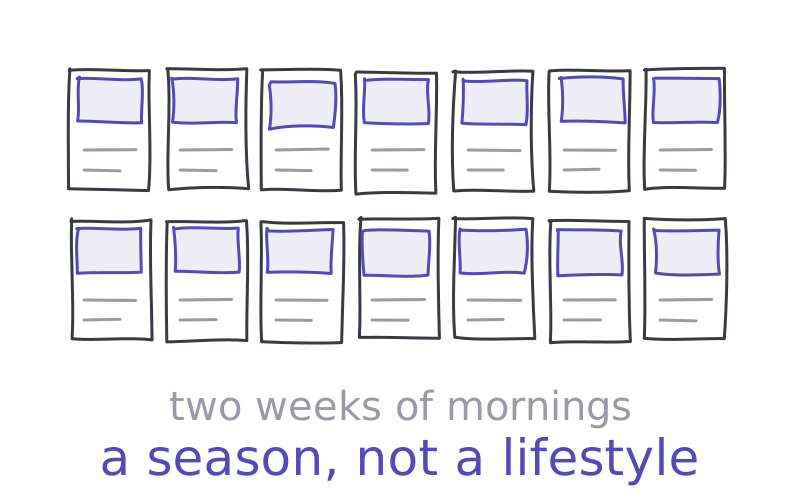
Sunday night. You’ve watched one more video about monk mode. Tomorrow it starts: no social media, no news, 5am alarm, deep work all day.
By Wednesday you’re back on your phone at lunch, and a bit annoyed with yourself.
The idea is good. The version is wrong
Monk mode means cutting out distractions for a while so you can put everything into one goal. A product launch, a book, an exam, a new business.
The idea behind it is right. Big, hard work needs long stretches of attention, and those stretches don't survive a phone that buzzes every few minutes.
The trouble is the version you see online. No end date. Every pleasure cut at once. A new routine for your whole life, started on a Monday.
That's not how monks live, either. They have a rule, a timetable and a place. The intensity comes from the structure, not from willpower.
The best monk mode had seasons
Cal Newport, who wrote Deep Work, likes the example of the economist Milton Friedman.
For years, Friedman spent three solid months a year at a second home in the country, keeping outside commitments to a minimum. Later, he split his life 50–50: six months in Chicago, six months in Vermont. Newport calls it an extreme version of what he names the bimodal method. You switch between two modes: deep, protected seasons, and normal working life.
Notice what Friedman didn't do. He didn't try to live in monk mode all year. He picked a season and a place, and went back to ordinary life after.
You probably can't leave for Vermont. But you can borrow the shape: a fixed period, fixed hours, and a clear switch back.
Why cutting everything backfires
Going completely cold turkey feels like the serious option. The research suggests it often isn't.
Nicholas Fitz and his colleagues tested phone notifications in a field experiment with 237 people. Some got them as usual, some in batches three times a day, and some not at all.
The batched group did best. They felt more attentive and productive, in a better mood, less stressed and more in control of their phones. The group with no notifications at all gained little, and felt more anxious, with more fear of missing out.
So monk mode doesn't mean nothing, ever. It means the important block is protected, and everything else waits for its turn. That's also why it works without heroic willpower: you're changing the setup, not fighting yourself every hour.
How to run two weeks of monk mode
Take fifteen minutes today to set it up.
Pick one goal and an end date. "Finish the first draft of the course by Friday the 31st." One goal, two weeks. When it ends, you stop, look back and decide whether to go again.
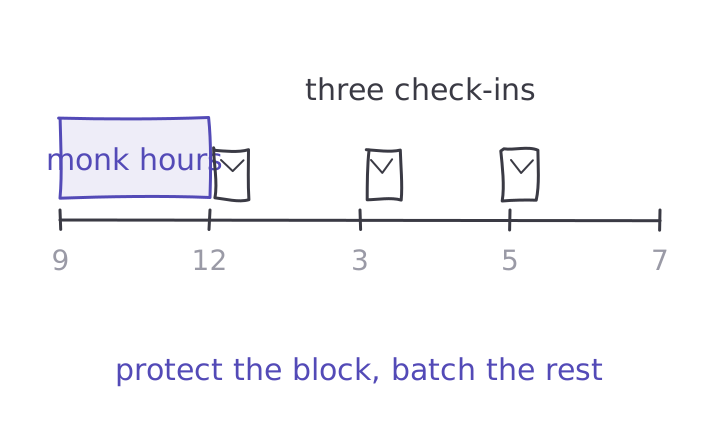
Set your monk hours. Two to three hours a day, ideally your sharpest ones. For many people that's the morning. Put them in your calendar as a meeting with yourself.
Change the place. Friedman had a house in the country. You might have a different room, a library desk, or just a separate browser profile with nothing logged in. A different place makes the switch obvious.
Batch the rest. Pick three times a day for email, messages and social media, like 12, 3 and 5. Outside those times, notifications stay off. Nothing gets deleted. It just waits.
Tell people. Let your team know your monk hours and when you'll reply. Most people are fine waiting until noon if they know noon is coming.
At the end of the two weeks, ask one question: did the goal move? If it did, keep the parts that helped and drop the rest.
So, what would you finish in two weeks if your mornings were yours?
Try it
During monk hours, the urge to check something will still come. CatchScroll catches it: a two-minute reset for the feeling behind the urge, then back to the block, with a focus timer that is free for good.
Try a reset free →
Sources
- 01Newport, C. — Milton Friedman’s deep work seasons: “three solid months in the country” each year, later a 50–50 split between Chicago and Vermont; “an extreme version of the bimodal method.” calnewport.com ↗
- 02Fitz, N. et al. — Batching smartphone notifications can improve well-being. Field experiment, 237 people: batched three times a day vs as usual vs never. Computers in Human Behavior 101, 84–94, 2019 ↗
- 03Duckworth, A. L., Gendler, T. S. & Gross, J. J. — Situational strategies for self-control. Perspectives on Psychological Science 11(1), 35–55, 2016 ↗