How to get into flow state at work: build it, don’t wait for it
Flow isn’t a lucky mood. It has three conditions, and you can set up all three before you start.
17 October 2026 · 4 min read
There was an afternoon last month when three hours just vanished. You looked up and the report was done.
Today you’ve been at it for forty minutes and you’ve opened Slack eleven times. Same desk. Same you. So what was different?
Flow happens at work more than anywhere
Flow is the name psychologist Mihaly Csikszentmihalyi gave to those hours: you're so absorbed that time disappears and the work seems to do itself.
We tend to think of it as rare. Something for artists and athletes, or for a lucky day.
But when Csikszentmihalyi's team followed 78 working adults for a week, asking them at random moments what they were doing and how it felt, most of the flow moments they reported happened at work. Not on the sofa, not on the weekend. At work.
Here's the funny part. The same people still felt more motivated in their free time than at work. You don't need to love your job to have flow in it. You need the right conditions.
What that good afternoon had
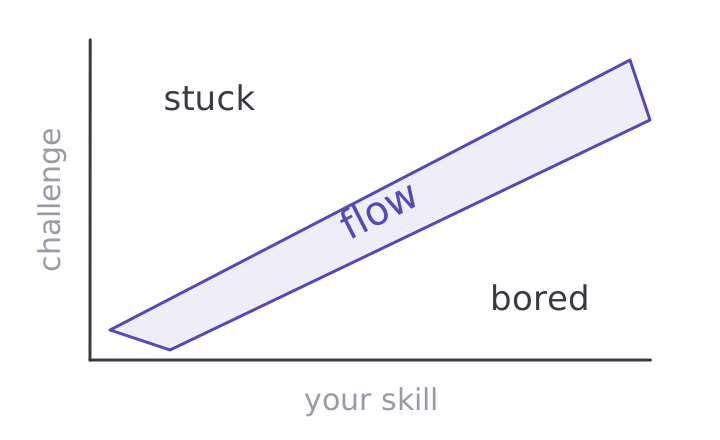
In his TED talk, Csikszentmihalyi describes flow from the inside. You know exactly what to do from one moment to the next. You get immediate feedback. And it happens when both the challenge and your skill are higher than usual for you.
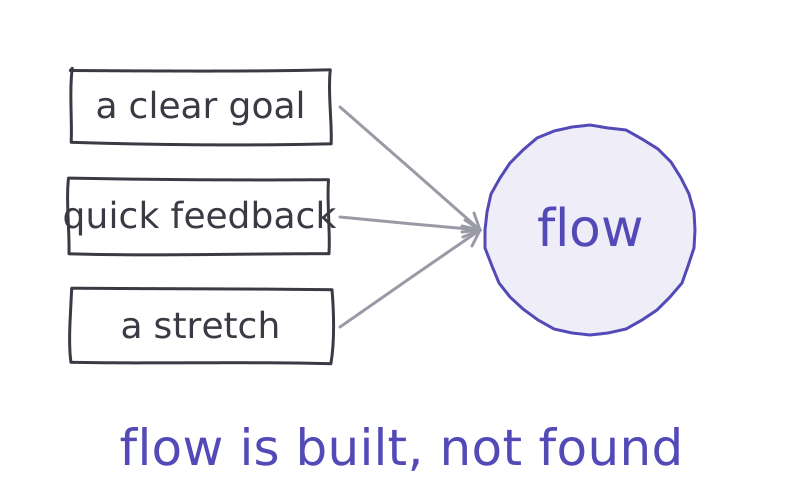
That gives you three conditions, and they're mostly about the task, not your mood.
A clear goal. Not "work on the report". You know what the next sentence, the next slide or the next test is.
Quick feedback. You can see right away whether it's working. The paragraph reads well. The numbers add up. The code runs.
A stretch. The task asks a bit more than is comfortable. Too easy, and your mind drifts off to look for something better. Too hard, and you get stuck and reach for your phone.
Think back to your good afternoon. It almost certainly had all three. Today's task probably has a vague goal, no feedback until someone reviews it, and the wrong level of difficulty.
What breaks it
Flow takes a while to build and a second to break.
The obvious enemy is the interruption. Cary Stothart and his team sent people phone notifications while they did an attention task. They didn't even pick up. Their performance still dropped.
The less obvious enemy is the half-finished thing. If you leave an unanswered email to start deep work, part of your mind stays with the email. Sophie Leroy and Theresa Glomb found that making a quick plan for how you'll come back to the unfinished task helps your mind let go of it. More on that in context switching.
Set up a flow block
You can't force flow, but you can set up the conditions in about ten minutes and let it come.
Park everything else. For each open loop, write one line: "Reply to Sam about the dates, after 12." Then close those tabs. Put your phone in a drawer or another room, not face down on the desk.
Write the goal for this block. One sentence with a finish line: "Draft the pricing section, three paragraphs." Then write the first move: "Open the doc and list the three prices."
Build in feedback. Break the goal into checkpoints you can tick as you go: each paragraph, each slide, each row of the model. Every tick tells you it's working.
Tune the stretch. If it feels dull, add a challenge: a time limit, or a higher standard ("make this slide work without a single bullet point"). If it feels too hard, shrink it, or spend the first ten minutes learning the bit you're missing.
Then give the block at least 45 minutes, and don't judge it by the first five.
So what's the one task on your list today that could give you that afternoon back?
Try it
When the urge to check something breaks the block, CatchScroll catches it: a two-minute reset for the feeling behind the urge, then back in, with a focus timer that is free for good.
Try a reset free →
Sources
- 01Csikszentmihalyi, M. & LeFevre, J. — Optimal experience in work and leisure. 78 adult workers sampled through the day for a week; “the great majority of flow experiences are reported when working, not when in leisure.” Journal of Personality and Social Psychology 56(5), 815–822, 1989 ↗
- 02Csikszentmihalyi, M. — Flow, the secret to happiness: in flow “you know exactly what you want to do from one moment to the other; you get immediate feedback,” with challenges and skills both higher than your average. TED, 2004 ↗
- 03Stothart, C., Mitchum, A. & Yehnert, C. — The attentional cost of receiving a cell phone notification. Journal of Experimental Psychology: Human Perception and Performance 41(4), 893–897, 2015 ↗
- 04Leroy, S. & Glomb, T. M. — Tasks interrupted: attention residue and how a “ready-to-resume” plan mitigates the effects. Four studies. Organization Science 29(3), 380–397, 2018 ↗