Imposter syndrome at work: the feeling isn’t proof
Feeling like a fraud tells you how you feel. It says nothing about how good you are.
8 October 2026 · 4 min read
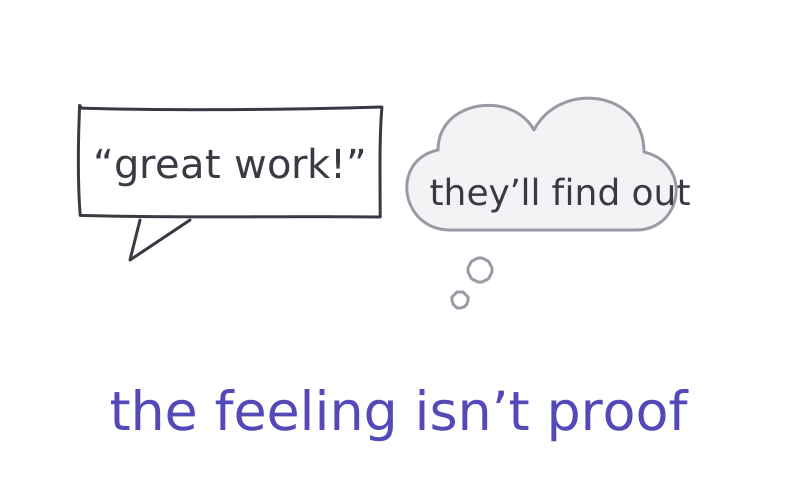
The client writes back: "Great work, this is exactly what we needed."
And your first thought isn’t relief. It’s: one day they’ll find out.
You’re not the only one
That voice has a name. Psychologists call it the impostor phenomenon: the belief that you're less capable than people think, and that sooner or later you'll be found out.
It's far more common than it feels. Dena Bravata and her team reviewed 62 studies covering 14,161 people. Depending on how it was measured, studies found it in anywhere from 9% to 82% of people. It showed up in men and women, from teenagers to senior professionals.
So the person in the meeting who looks the most sure of themselves? There's a fair chance they're thinking the same thing. Nobody says it, because everyone assumes they're the only one. So everyone stays quiet, and the feeling gets to look like a fact.
Why it hurts your work
The feeling itself isn't the problem. What it makes you do is.
You redo the slides a fourth time. You don't pitch the idea in the meeting. You put off the proposal, because if you never send it, nobody can judge it. Then your phone looks very inviting.
Notice how the voice talks, too. It never says "slide 6 has a wrong number." It says "you're not good enough." Real feedback is specific. The impostor voice is vague, which is exactly what makes it so hard to argue with.
Bravata's review found the impostor feeling often comes with anxiety and depression, and goes with weaker job performance, lower job satisfaction and burnout.
A surprising upside
Here's the part most articles miss. Basima Tewfik at MIT studied employees at an investment firm, doctors in training, and people in mock job interviews.
People with more frequent impostor thoughts tended to be better with others at work. Her explanation: worried they might not be competent enough, they make up for it. They turn their attention outward, to the person in front of them. Tewfik calls it a compensation story. She found no sign that their competence was any worse.
The thoughts still hurt their self-esteem. So this isn't a reason to keep the feeling. It's a reason to stop treating it as a verdict.
The feeling is not a measure of your skill. It's a feeling.
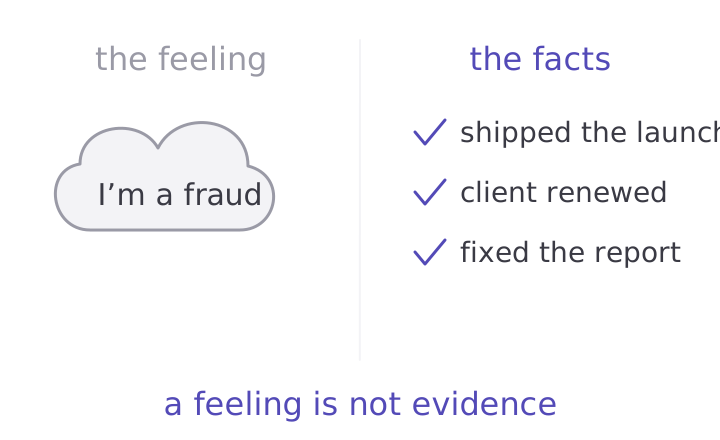
Separate the feeling from the facts
You can't argue a feeling away. But you can stop letting it make your decisions.
When the voice starts, name it in one word: "There's the fraud feeling." A UCLA team led by Matthew Lieberman found that putting a feeling into words calms the brain's alarm response. It turns a judgement into something that's just passing through.
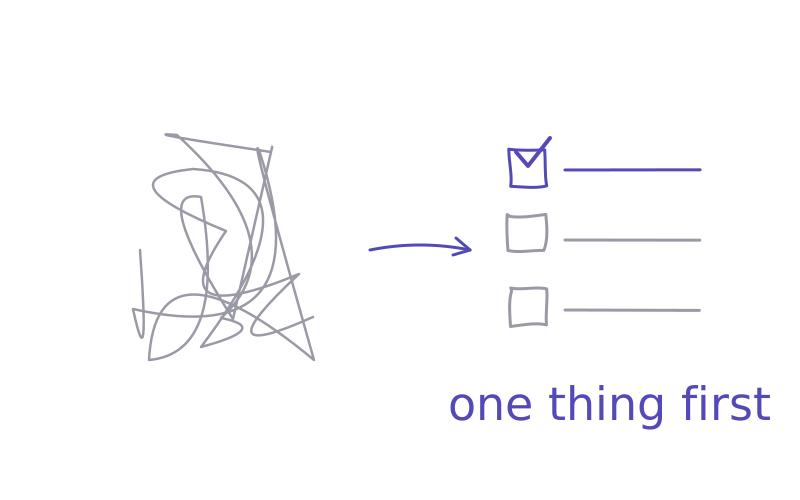
Then check the facts. Open a note and write three specific things you delivered this year, and who they helped. Not "I'm good at my job." Something like: "rebuilt the onboarding emails, and sign-ups went up." Keep the note. Read it before the next big meeting.
And keep the upside. Use the worry to do what it's already pushing you to do: ask the client one more question about what they really need. That's not covering up. That's good work.
Then say it out loud to one colleague you trust. Given how common it is, there's a good chance they'll say "me too."
If the doubt is loud enough that you can't start, it's the same pattern as any hard task at work: the feeling arrives first, and the proof comes later.
So what's one thing you did this year that the voice conveniently forgets?
Try it
The doubt will come back. When it stops you starting, CatchScroll has a two-minute reset made for self-doubt, then sends you back to the work, with a focus timer that is free for good.
Try a reset free →
Sources
- 01Bravata, D. M. et al. — Prevalence, predictors, and treatment of impostor syndrome: a systematic review of 62 studies, 14,161 participants; prevalence 9–82% depending on the tool. Journal of General Internal Medicine 35(4), 1252–1275, 2020 ↗
- 02Tewfik, B. — The impostor phenomenon revisited: workplace impostor thoughts and interpersonal effectiveness at work. Summary by MIT Sloan. Academy of Management Journal 65(3), 988–1018, 2022 ↗
- 03Lieberman, M. D. et al. — Putting feelings into words: affect labelling disrupts amygdala activity. Psychological Science 18(5), 421–428, 2007 ↗