Parkinson’s law: why work takes all the time you give it
More time doesn’t make a task easier. Often it makes it feel harder.
17 October 2026 · 4 min read
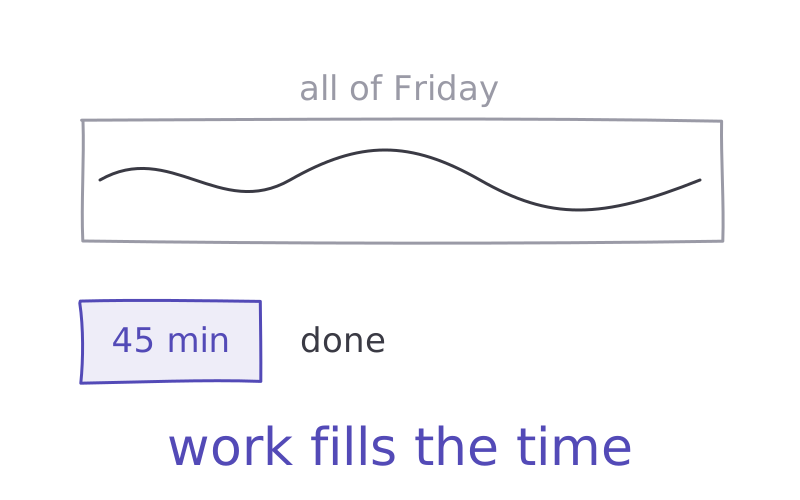
You have all of Friday to write a two-page update. At 4:30 you’re still polishing the first paragraph.
Give the same update a 45-minute slot on Tuesday, and it’s done in 45 minutes.
A joke that became a law
In 1955, the historian C. Northcote Parkinson wrote a joke essay for The Economist magazine. It opened with a line that outlived everything else in it: "Work expands so as to fill the time available for its completion."
Most of the essay was a joke about the British civil service, and how officials make work for each other. But the first line stuck, because everyone recognises it. Give a task a week, and it takes a week. Give it an hour, and somehow it fits.
The interesting question is why.
More time can make a task feel harder
Meng Zhu and her colleagues found one reason. In three experiments, people who were given a distant deadline for a task saw that task as more difficult. They planned to spend more time and money on it. In real life, that's how a task gets put off, or quietly dropped.
The effect was weaker in two cases: when the task was well defined, with a clear way to do it, and when people had done that kind of task before.
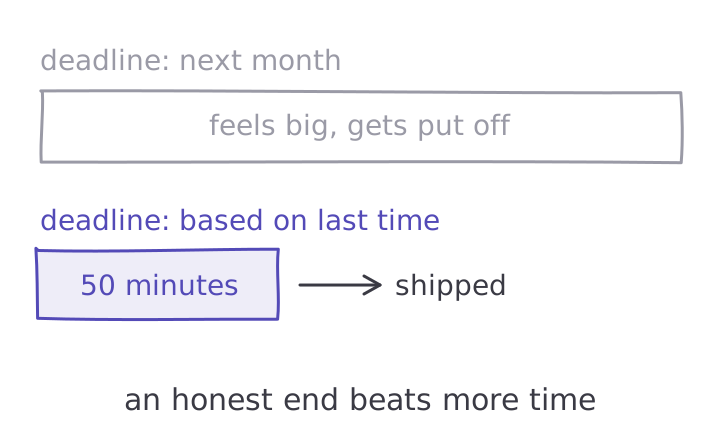
You've probably seen the opposite too. The report due "sometime next month" sits untouched for three weeks, then gets written in two evenings. It was never a three-week job. The far deadline just made it feel like one.
That's the Friday update. "Write the update" with a whole day attached feels like a big job. "Write three paragraphs: done, next, blocked" in 45 minutes feels like what it is.
But don’t just cut the time
Here's the catch. We're also bad at guessing how long things take.
Roger Buehler, Dale Griffin and Michael Ross asked 37 students how long their final-year project would take. On average they said 33.9 days. It took 55.5. Fewer than a third finished in the time they predicted, and even their worst-case guesses were too short.
So a tight deadline you pulled out of the air will just make you late. In the same research, one thing removed the bias: getting people to link their prediction to how long similar work had taken them before.
The goal is an honest deadline. Short, but based on last time.
How to make Parkinson’s law work for you
Try it on one task today.
Define done. Write what finished looks like in one line: "Three paragraphs: done, next, blocked." A clear task is the one the long deadline can't inflate.
Check last time. How long did the last update, proposal or report like this actually take? Look at your calendar or sent folder if you're not sure. Use that number, not your hopeful one.
Give it a block with an end. Put that time in your calendar, ideally early in the day. The full method is in time blocking.
Keep the end visible. A timer you can see, or a calendar alert five minutes before, keeps the deadline real while you work.
For big projects, set the deadline on the next chunk. "Finish the report by the 30th" is too far away to feel. "Draft section two by 11am" isn't.
Stop at the end. When time's up, send the good-enough version, or decide on purpose to give it one more block. Then write down how long it really took, so next time's estimate is better.
So, which task on your list has been given far more time than it needs?
Try it
Short blocks only work if you stay in them. When the urge to check something hits, CatchScroll gives you a two-minute reset for the feeling behind it, and a focus timer that is free for good.
Try a reset free →
Sources
- 01Parkinson, C. N. — Parkinson’s law: “Work expands so as to fill the time available for its completion.” A satirical essay on how officials make work for each other. The Economist, 19 November 1955 ↗
- 02Zhu, M., Yang, Y. & Hsee, C. K. — The mere urgency effect. Five experiments: people chose urgent tasks over important ones with better payoffs; stronger in people who feel busy, weaker when reminded of payoffs. Also Zhu et al., the mere deadline effect: distant deadlines made tasks seem harder. Journal of Consumer Research, 2018 (summary: Johns Hopkins Hub) ↗
- 03Buehler, R., Griffin, D. & Ross, M. — Exploring the “planning fallacy”. 37 honours students predicted 33.9 days for their thesis and took 55.5; 29.7% finished on time. Linking predictions to past experience removed the bias. Journal of Personality and Social Psychology 67(3), 366–381, 1994 ↗