Decision fatigue: why choosing gets harder as the day goes on
You don’t run out of willpower. A day of hard thinking makes every extra effort feel bigger, so plan your choices for the morning.
17 October 2026 · 5 min read
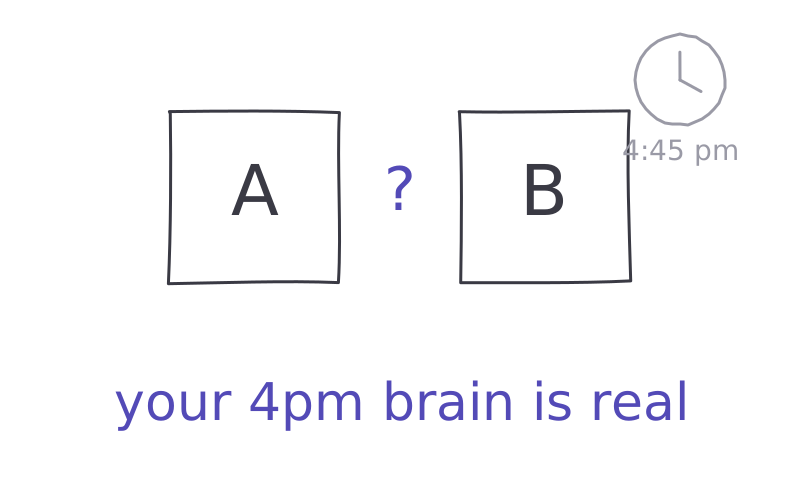
4:45 pm. Someone asks which of two logos you prefer, and you genuinely don’t care.
You’ve probably heard why: every decision uses up a little willpower, like fuel in a tank. The real reason is different, and more useful.
The hungry judges
The most famous evidence for decision fatigue comes from Israeli parole boards. In 2011, Shai Danziger, Jonathan Levav and Liora Avnaim-Pesso looked at the order of rulings through each day. Favourable decisions started at about 65% at the beginning of each session, fell to nearly zero by the end, and jumped back up after the judges' food break.
It became one of the most quoted findings in psychology. Judges get tired of deciding, so they fall back on the easy answer: no.
Why that story is probably wrong
Later the same year, Keren Weinshall-Margel and John Shapard went back to the data and talked to people who worked in those hearings. The order of cases wasn't random. The board tried to finish all the cases from one prison before a break. And within each session, prisoners without a lawyer usually went last, and they were less likely to get parole anyway.
So the drop may say more about who was heard last than about tired judges.
The bigger idea behind it, that willpower is a tank that runs down as you use it, has also failed a big test. In 2016, 23 labs ran the same willpower experiment with 2,141 people. They found almost no effect.
What actually happens to your brain
So is your 4:45 brain imagining things? No.
A team at the Paris Brain Institute led by Antonius Wiehler and Mathias Pessiglione had people do hard mental work for most of a day, while another group did an easier version. By the end of the day, the hard-work group had more of a chemical that builds up during intense thinking, in the part of the brain used for self-control. And their choices changed: they picked options that took less effort and paid off sooner.
So it isn't that each small decision uses up a fixed supply. It's that after a day of hard thinking, any extra effort feels bigger than it did in the morning. Which is why the logo question at 4:45 gets a shrug, and why the same question at 9:30 might have got a real answer. More on this in brain fog at work.
How to plan your decisions
You can't stop the afternoon from coming, but you can choose what's waiting for you there.
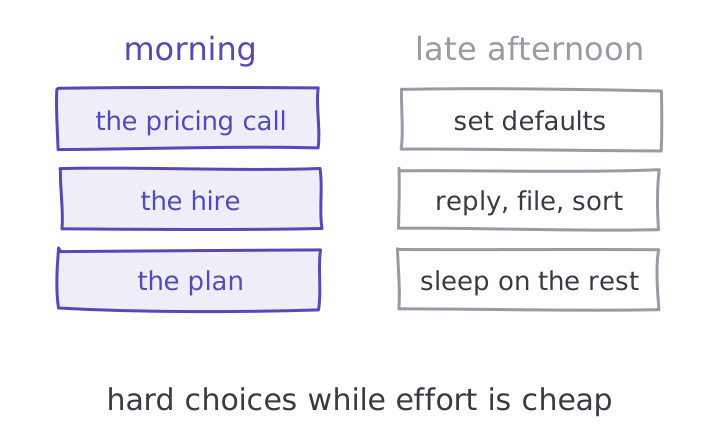
Put the big decisions first. Pricing, hiring, the plan for the quarter: give them your first hours, before the inbox and the meetings.
Decide the small, repeated things once. Standing meeting slots, a default lunch, a template reply for common requests. Each one is one less thing to think through later, when thinking costs more.
Write the decision down first. One line on what you're deciding and why it matters makes it easier to pick up again tomorrow, instead of thinking it all through from scratch.
Sleep on late decisions that can wait. If a choice lands at 4pm and isn't urgent, write down the options and the one-line case for each, then decide in the morning.
Cut the options. For any decision, narrow it to two or three real choices before you weigh them. Comparing six logos at once is hard work at any time of day.
Notice the tell. When you catch yourself picking whatever's easiest, or saying "whatever you think", that's your cue for a real break, or for parking the decision.
So, which decision on your list deserves your best hour tomorrow?
Try it
When a tired afternoon turns into scrolling, CatchScroll catches it: a two-minute reset for how you actually feel, so you can get back to the work, or decide to stop for the day on purpose.
Try a reset free →
Sources
- 01Danziger, S., Levav, J. & Avnaim-Pesso, L. — Extraneous factors in judicial decisions: favourable parole rulings fell from about 65% to nearly zero within each session and rose again after a food break. PNAS 108(17), 6889–6892, 2011 ↗
- 02Weinshall-Margel, K. & Shapard, J. — Overlooked factors in the analysis of parole decisions: case order was not random; unrepresented prisoners usually went last in each session. PNAS 108(42), E833, 2011 ↗
- 03Hagger, M. S. et al. — A multilab preregistered replication of the ego-depletion effect: 23 labs, 2,141 people, effect d = 0.04 with a confidence interval that includes zero. Perspectives on Psychological Science 11(4), 546–573, 2016 ↗
- 04Wiehler, A., Branzoli, F., Adanyeguh, I., Mochel, F. & Pessiglione, M. — A neuro-metabolic account of why daylong cognitive work alters the control of economic decisions: higher glutamate in the lateral prefrontal cortex after high-demand work. Current Biology 32(16), 2022 ↗