How to break phone addiction without throwing your phone away
You don’t need a flip phone or iron willpower. You need a few small changes that make the reach slower.
20 October 2026 · 5 min read
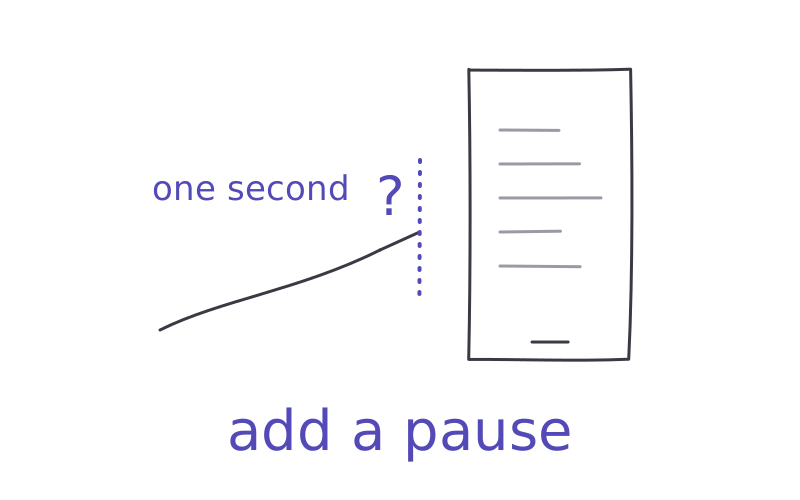
You pick up your phone to check the time. Twenty minutes later you put it down. You still don’t know what time it is.
If that sounds like you, you’re not weak. Whether you call it an addiction or a habit, it runs on the same loop, and a loop can be broken in more than one place.
It’s a loop, not a lack of willpower
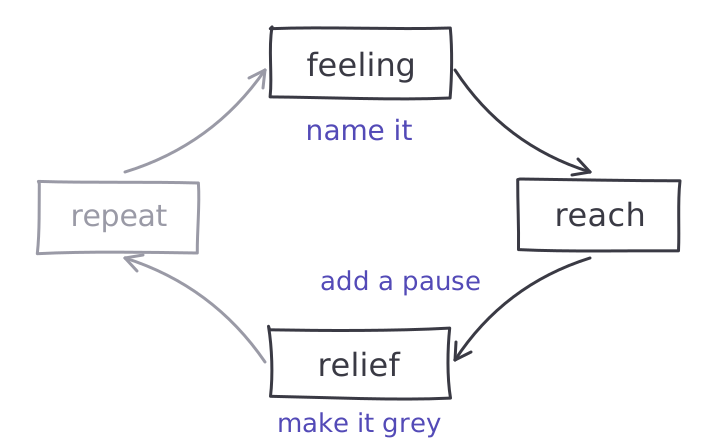
Here's the loop. A small uncomfortable feeling: bored, stuck, a bit anxious. A reach. A quick hit of relief from the screen. Then back to the feeling, a little later and a little more tired.
Most of the time the phone doesn't even start it. When London School of Economics researchers filmed people's everyday phone use, 89% of pickups were started by the person, not by a notification.
That's actually good news. If the loop starts with you, you can change it. You don't have to win every fight. You only have to make the reach a bit slower, a bit less rewarding, or a bit less needed.
Make the phone a little more boring
Colour is part of the pull. In a field experiment with 112 people, Lisa Zimmermann and Maxim Sobolev compared two fixes. Switching the phone to grayscale cut screen time straight away. Setting yourself a time limit worked less, and more slowly.
A 2026 trial with 51 medical students found the same thing: in their grayscale week, they used their phones about 28 minutes less a day.
Notifications are the other half. Nicholas Fitz and his team tested 237 people. The ones who got their notifications in three batches a day felt more attentive, less stressed and more in control than people who got them as usual. Switching them off completely backfired: people felt more anxious about missing things.
So you don't need silence. You need fewer, grouped pings.
Put a pause between you and the app
The reach is fast. Often it's done before you notice. A short pause gives you a moment to choose.
The app one sec does exactly that: when you open a chosen app, it makes you wait a few seconds and asks if you still want to. In a study of 280 people over six weeks, people closed the app again about a third of the time. By the end, they opened those apps 57% less. (One of the authors created the app, so read that with care. But the idea is simple enough to test yourself.)
You can add a pause without any app, too. Move social apps off your home screen into a folder on the last page. Log out after each use, so getting back in takes a password. Each bit of effort is a moment to change your mind.
Use distance, not willpower
A phone on your desk is a decision you have to make every few minutes. A phone in your bag across the room is a decision you made once.
Distance also protects your breaks. In a study of 414 people, those who spent their break on their phone solved fewer problems afterwards than people who took the same break on paper or a computer.
And cutting back on scrolling can help more than your focus. In a University of Pennsylvania study, 143 students limited themselves to 10 minutes a day on each of Facebook, Instagram and Snapchat for three weeks. They felt less lonely and less depressed than the students who carried on as normal.
Six changes for this week
Don't try all six on day one. Pick two, keep them for a week, then add more.
Turn on grayscale. Batch your notifications into three times a day. Move social apps off your home screen, or add a pause before they open. Charge your phone outside the bedroom. Put it in your bag during your focus blocks. And when the reach comes anyway, stop for a second and name the feeling in one word: bored, anxious, stuck. A UCLA study found that putting a feeling into words calms the brain's alarm response, which is often enough to let the urge pass.
More on that last step in why you can't stop checking your phone and urge surfing. If the scroll is the main problem, how to stop doomscrolling goes deeper.
So next time you pick up your phone to check the time: what were you feeling one second before?
Try it
The changes above slow the reach. CatchScroll helps with the feeling behind it: when the urge hits during work, tap what you feel and take a two-minute reset made for it. Try it free for 7 days.
Try a reset free →
Sources
- 01Heitmayer, M. & Lahlou, S. — Smartphone use is initiated by the user in 89% of interactions. Computers in Human Behavior, 2021 ↗
- 02Zimmermann, L. & Sobolev, M. — Digital strategies for screen time reduction: a randomized field experiment, 112 people. Grayscale cut screen time straight away; self-set time limits cut it less, and more slowly. Cyberpsychology, Behavior, and Social Networking 26(1), 42–49, 2023 ↗
- 03Hagerty, J. et al. — A cross-over feasibility trial of smartphone grayscale mode in medical students. 51 people; grayscale weeks averaged 28 minutes less screen time a day. Frontiers in Digital Health 8, 2026 ↗
- 04Fitz, N. et al. — Batching smartphone notifications can improve well-being. Field experiment, 237 people: batched three times a day vs as usual vs never. Computers in Human Behavior 101, 84–94, 2019 ↗
- 05Grüning, D. J., Riedel, F. & Lorenz-Spreen, P. — Directing smartphone use through the self-nudge app one sec. 280 people over 6 weeks: 36% of attempts closed after the pause; app openings down 57%. One author created the app. PNAS 120(8), e2213114120, 2023 ↗
- 06Kang, S. & Kurtzberg, T. R. — Reach for your cell phone at your own risk: the cognitive costs of media choice for breaks. 414 participants. Journal of Behavioral Addictions 8(3), 395–403, 2019 ↗
- 07Hunt, M. G. et al. — No more FOMO: limiting social media decreases loneliness and depression. 143 students limited to 10 minutes per platform a day for three weeks. Journal of Social and Clinical Psychology 37(10), 2018 (summary: Penn Today) ↗
- 08Lieberman, M. D. et al. — Putting feelings into words: affect labelling disrupts amygdala activity. Psychological Science 18(5), 421–428, 2007 ↗