Why can’t I focus? Four reasons, and how to tell which is yours
“Can’t focus” isn’t one problem. Find the one you have today, and the fix gets much smaller.
12 October 2026 · 5 min read
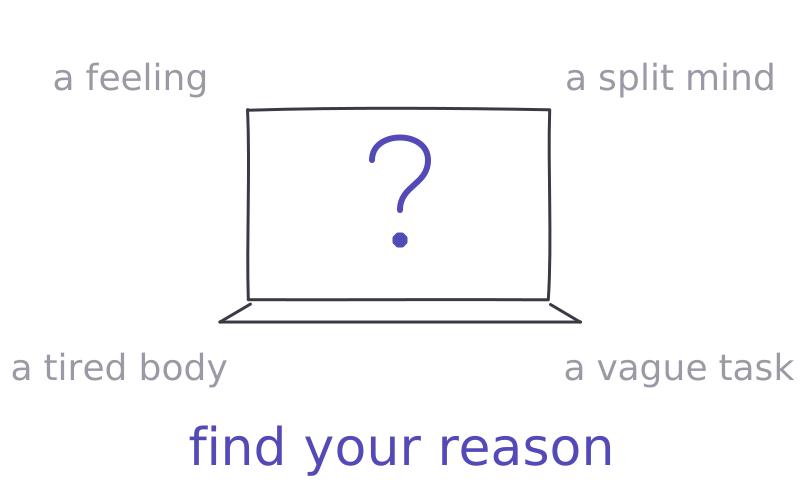
It’s 2pm. You’ve read the same paragraph three times. You’ve checked your phone twice, and you couldn’t say what was on it.
Telling yourself to concentrate harder doesn’t work, because “I can’t focus” isn’t one problem. Most days it’s one of four, and each has a different fix.
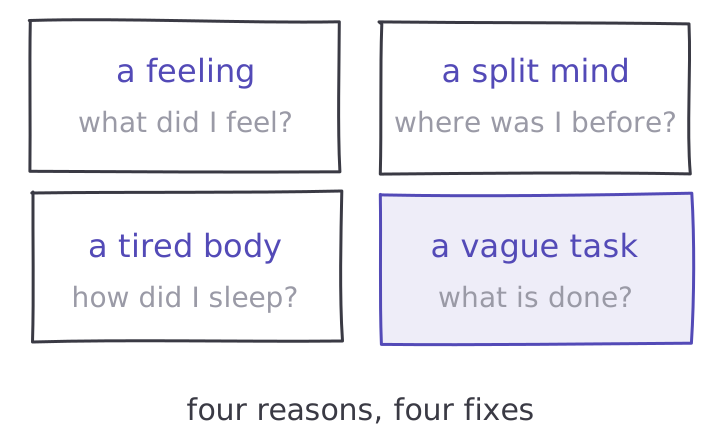
A feeling you’d rather not have
The task feels boring, or hard, or unclear, or a bit scary. So your attention leaves, and takes your hand to the phone with it.
Psychologists Fuschia Sirois and Timothy Pychyl describe procrastination as short-term mood repair: we put off the task to feel better right now. Nir Eyal makes the same point about distraction. Look for the discomfort that comes just before it.
The test: what did I feel one second before I switched? If you can name it, this is your reason. Why we doomscroll covers the six feelings that come up most.
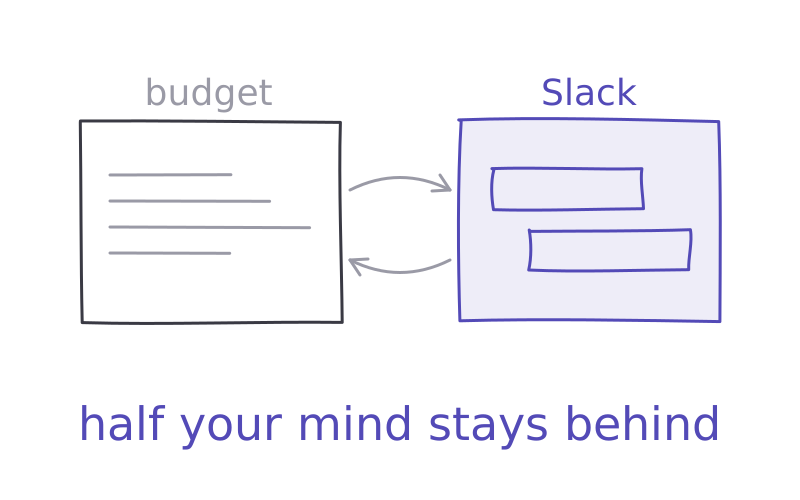
Half your mind is still somewhere else
You came out of a meeting, answered a message, or left a task half done. Now you're trying to start something new, and part of you is still back there.
Sophie Leroy and Theresa Glomb call this attention residue. When people were pulled away from unfinished work, part of their mind stayed on it, and they did worse on the next task.
The test: what was I doing just before this? If the answer is "something I didn't finish", this is your reason.
Your body is running low
Sometimes it's not you, it's the battery. When Julian Lim and David Dinges combined 70 studies of people kept awake, simple attention was hit hardest: people had many more lapses. Reasoning hardly changed.
Even on a good night's sleep, focus comes and goes. Gloria Mark, who studies attention at work, finds that focused attention comes in rhythms through the day, rising and falling with the mental energy you have left.
The test: did I sleep badly, skip lunch, or have I been at this for hours? If yes, this is your reason.
The task has no edges
"Work on the strategy." "Sort out the budget." Tasks like these give your mind nothing to hold on to, so it drifts to something that does.
Vague goals also follow you around. E.J. Masicampo and Roy Baumeister found that unfinished goals kept popping into people's heads and hurt their performance on other tasks. When people made a specific plan for those goals, the effect went away.
The test: could I say what "done" looks like for the next half hour? If not, this is your reason.
What to do in the next five minutes
If it's a feeling, name it out loud or on paper, take a slow breath, and do the smallest piece of the task: one sentence, one cell.
If it's a split mind, write one line about where you left the other thing ("next: reply to Sam about the dates"). Then close it.
If it's a tired body, stop pushing. Take a ten-minute break away from the screen, eat something, and save the hard work for your best hour tomorrow. Do the easy jobs now.
If it's a vague task, write the next physical step: "Open the budget file and fill in March." Set a timer for 25 minutes and do only that. Clear goals are also the first condition for flow.
If you can't focus most days for weeks, and none of this helps, talk to your doctor. Poor sleep, stress, low mood and ADHD can all show up as trouble focusing.
So, which of the four is it for you right now?
Try it
CatchScroll helps with the first reason, the one most advice skips: a two-minute reset matched to the feeling behind the urge, then back to the work, with a focus timer that is free for good.
Try a reset free →
Sources
- 01Sirois, F. & Pychyl, T. — Procrastination and the priority of short-term mood regulation. Social and Personality Psychology Compass 7(2), 115–127, 2013 ↗
- 02Eyal, N. — The 4 steps to becoming indistractable: internal triggers first, precommitments last. nirandfar.com ↗
- 03Leroy, S. & Glomb, T. M. — Tasks interrupted: attention residue and how a “ready-to-resume” plan mitigates the effects. Four studies. Organization Science 29(3), 380–397, 2018 ↗
- 04Lim, J. & Dinges, D. F. — A meta-analysis of the impact of short-term sleep deprivation on cognitive variables: 70 articles; lapses in simple attention hit hardest, reasoning accuracy barely affected. Psychological Bulletin 136(3), 375–389, 2010 ↗
- 05Mark, G., interviewed by the American Psychological Association — Why our attention spans are shrinking: average time on one screen 2.5 minutes (2004), 75 seconds (around 2012), about 47 seconds in recent years (median 40). Speaking of Psychology, APA, 2023 ↗
- 06Masicampo, E. J. & Baumeister, R. F. — Consider it done! Plan making can eliminate the cognitive effects of unfulfilled goals. Journal of Personality and Social Psychology 101(4), 667–683, 2011 ↗