Indistractable, summarised: four steps, in the order that works
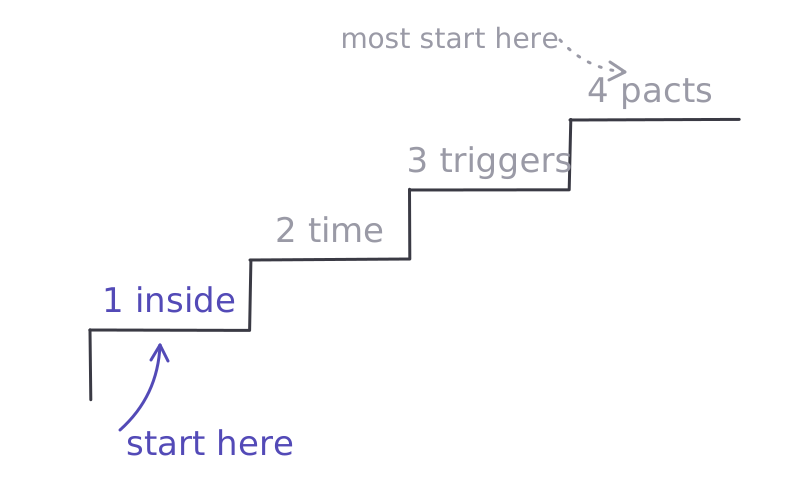
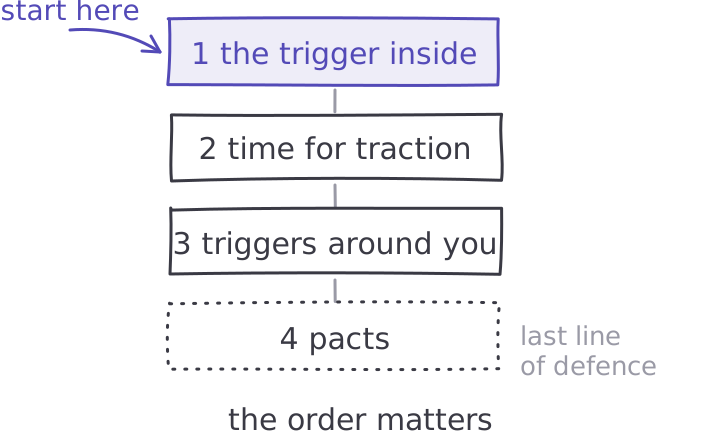
Most of us start with step four. Nir Eyal calls it the last line of defence.
12 October 2026 · 5 min read
You installed the blocker. You turned off the notifications. You bought the timer. And you still lost Tuesday afternoon to tabs.
Nir Eyal’s book Indistractable has a simple explanation: you started at the end. Here’s the whole method, step by step, and how to try it this week.
Traction and distraction
Eyal starts with two words. Traction is anything that pulls you toward what you want in life. Distraction is anything that pushes you away from it.
The point is that the activity doesn't decide which is which. Your plan does. Email at 9am is traction if 9am was for email. It's distraction if 9am was for the proposal. Eyal goes further: "the time you've planned to waste is not wasted time." Productive procrastination shows how this plays out at work.
Both kinds start with a trigger. External triggers are around you: pings, people, a TV in the corner. Internal triggers come from inside you, like hunger, stress or boredom.
Step 1: master the trigger inside
Eyal says distraction starts from within, and that it isn't really about the distracting thing. It's about how you respond to the feeling that came before it.
He gives four moves. Look for the discomfort just before the distraction. Write it down. Explore the feeling with curiosity, not contempt. And be extra careful in the in-between moments, when you move from one activity to the next.
This is the step most people skip. It's also the one that makes the rest work. Urge surfing is a good way to practise it.
Step 2: make time for traction
You can't call something a distraction unless you know what it's distracting you from. So step two is a plan for your day.
Eyal splits life into three areas: work, relationships and you. Each gets time on the calendar. Then you check the plan with the people it affects, like your manager or your partner.
At work, this looks like time blocking: a block for the proposal, a block for email, a block for nothing in particular.
Step 3: hack back the triggers around you
Now look at the pings and dings. Eyal's list of top offenders is familiar: interruptions, email, group chat, meetings, your phone, your desktop, articles and feeds.
For each one, ask whether it's working for you, or you're working for it. Keep the ones that help. Mute, move or batch the rest. In one field experiment, people whose phone notifications arrived in three batches a day reported better well-being than people who got them as usual.
Step 4: pacts, last
Only now does Eyal bring in precommitment: removing a choice in advance, so the impulse can't win later. He describes three kinds of pact.
An effort pact makes distraction harder, like a blocker or a phone in a drawer. A price pact puts money on the line. An identity pact changes how you see yourself: "I'm someone who doesn't check my phone in meetings."
He's clear that pacts come after the other three steps, not instead of them. Without the first three, a blocker guards one door and leaves the rest open. Do app blockers work? looks at the evidence.
Try it this week
You don't need the whole book to start. One step a day is enough.
Monday: each time you switch away from your work, write down what you felt just before. Three entries is plenty.
Tuesday: plan Wednesday in blocks the evening before, including a block for things you enjoy.
Wednesday: pick one notification that isn't working for you and turn it off.
Thursday: make one effort pact. Phone in a drawer for your first block of the day.
Friday: look back at Monday's notes. The same one or two feelings usually turn up again and again. Those are your triggers.
So which step have you been skipping?
Try it
Step one is where CatchScroll comes in: when the urge to switch hits, name the feeling behind it and take a two-minute reset matched to it, then go back to your block. The focus timer is free for good.
Try a reset free →
Sources
- 01Eyal, N. — The 4 steps to becoming indistractable: internal triggers first, precommitments last. nirandfar.com ↗
- 02Fitz, N. et al. — Batching smartphone notifications can improve well-being. Field experiment, 237 people: batched three times a day vs as usual vs never. Computers in Human Behavior 101, 84–94, 2019 ↗